If you were hoping for a post on romance and love spells, well, I am sorry to maybe disappoint you. I may try to throw a little something in at the end of this post for those of you really wanting that vibe. But really, this year has me more in the mood for celebrating the love for friends, and even self. I adore my sweetheart, and we have plenty of romance in our lives even still after 30 plus years of being together. But lately I have found myself also super grateful for my beautiful circle of friends, and how they have led me into my own practice of self-love.
Surrounding yourself with people who hold a similar vibration to you is so soothing and beautiful. It’s harmonious and peaceful, easy and crazy fun. I feel so lucky to have a large handful of such friends in my life right now. I want to celebrate these sacred relationships and give thanks to the Universe for the connections we have. So most of my Valentine’s Day will be doing just that. I plan to take a moment at my altar to meditate and say a prayer of gratitude and love for these divine friendships. And then I plan to do some self care afterwards. After all, being in my best form helps me to be the best for those I love too. We have to take care of ourselves first, so that we can have a full cup if we need to offer some of ourselves to others.
I used to sort of roll my eyes at self-care. But I get it now. I’m not going to pretend I am perfect at it by any means, but I am getting better at it every day. It really has helped me to be the best version of myself. And when my cup is full, I have more to give to my husband, and children, and everyone I love.
So if you are planning on doing Valentine’s Day differently this year too, please feel free to sample my plans if you like. And if you plan to make it about romance, then tuck this away for later when you are ready for your own time.
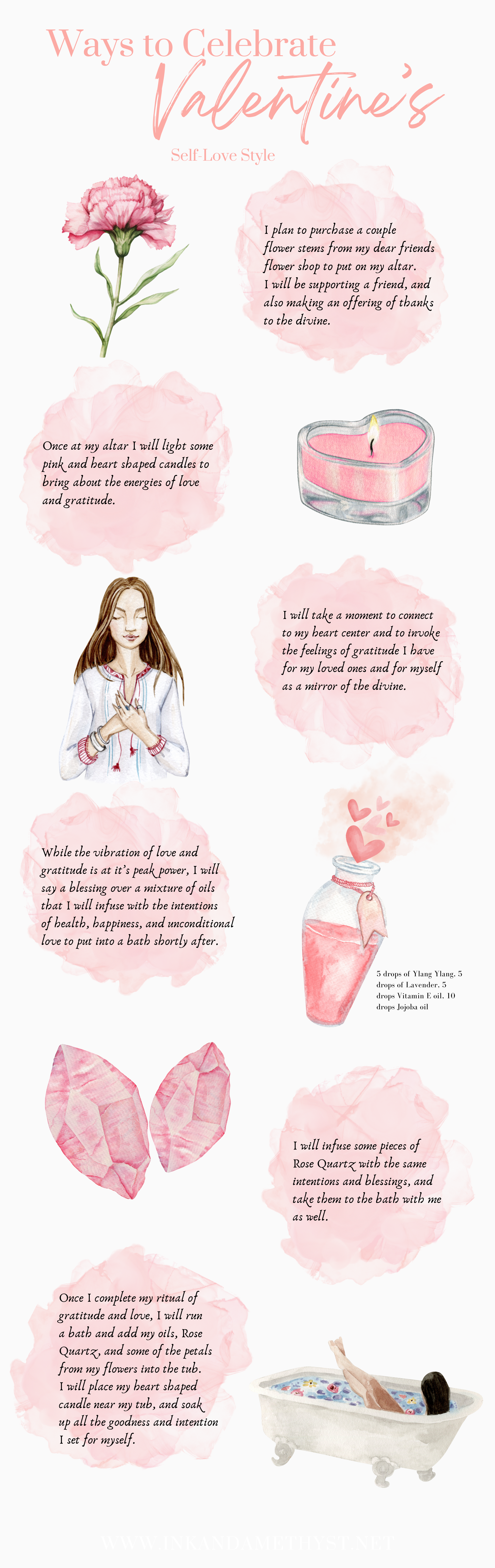
Here’s how I plan to celebrate this year-
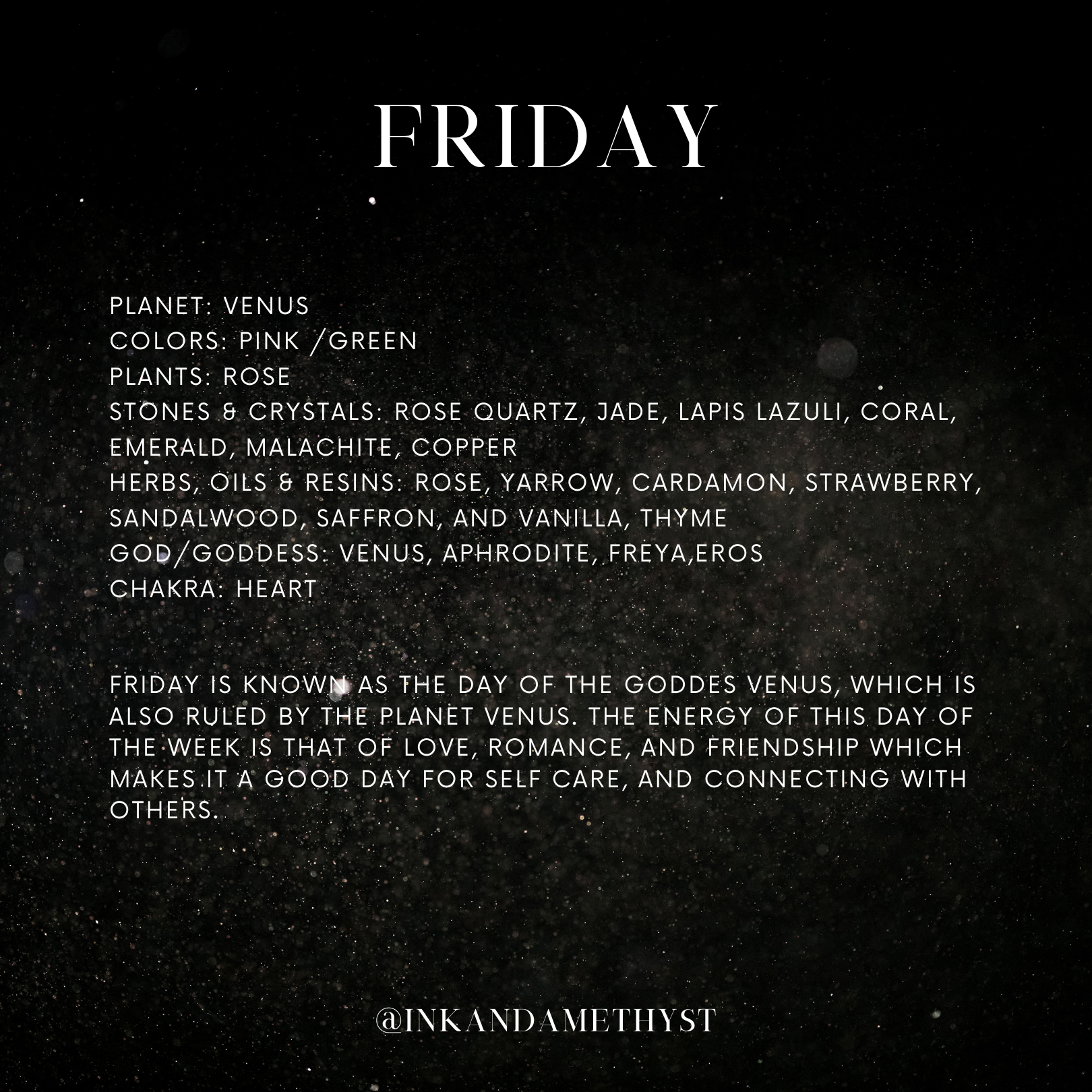
And if you are planning to celebrate romantically, go for it! I do think it’s rather special that Valentine’s Day falls on Friday this year. After-all, Friday is ruled by the planet Venus, and is the day for all things love related. So you will surely have all that energy working for you and boosting those romantic moments!
Be sure to wear pink for another extra boost too! And if you want to know about sexy time crystals, read this. Or want to know how to maybe keep the bedroom mojo working longer, read here.
However you choose to celebrate this Valentine’s Day, I hope you have a wonderful time, and that above all, you know you are loved.
This February’s Flower is the Carnation. Mostly because I already highlighted the Rose here. When I think of February, I think of Valentine’s Day, and when I think of Valentines I think of Roses. But Carnation is a good choice as it’s a popular flower due to its ability to grow well, which makes it an affordable option for most people. When I think of Carnation I think of friendship more than romance. And that kind of goes along with this years Valentines theme for me personally. Don’t get me wrong, I like romance too, and my life has its fair share as I’ve been married for almost 30 years to my sweetheart. But sometimes friendship and self-love need to be celebrated too, and I have found myself more in the mood for that this season as I am super grateful for the community of friends I have this year.
A little Carnation history
The Carnation is one of the oldest cultivated flowers. It has been around since the Greek and Roman times. Some legends say that the Greek botanist Theophrastus gave the flower the scientific name of Dianthus which is a combination of the Greek words Dios, which means divine or “of Zues” and Anthos, the word for flower. So it was known as “The flower of Zues”.
Another legend of the Carnation is that the flower sprung up where each tear of the Virgin Mary fell after Christ’s crucifixion. And thus the name “Carnation” comes from Christ being the “incarnation” of God as man.
Originally a wild plant in Europe, it was introduced to England by the Normans and later cultivated and bred in many varieties by the Victorians in an almost endless variety of colors and variegations.
The Victorian Language of Flowers
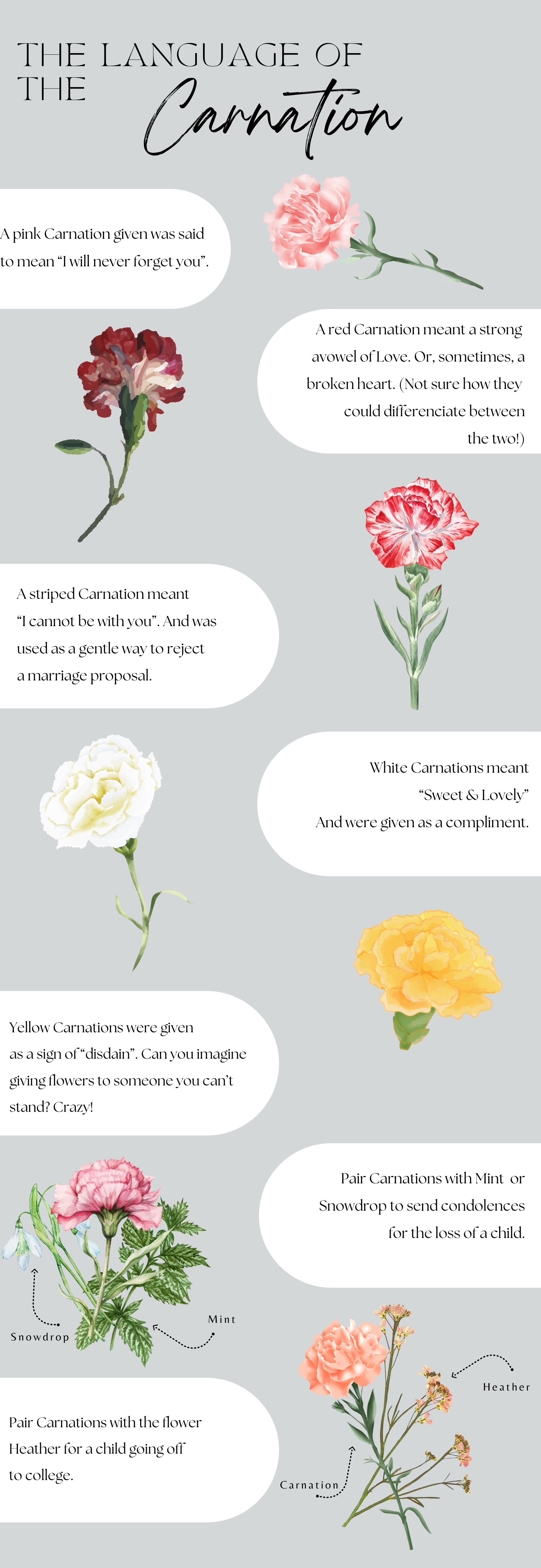
Those of you who have been reading the blog regularly know about the Victorian Language of Flowers that sparked my interest a while ago. You can read more on that here. The diagram below shows how Carnation was used in this strange but obviously beautiful language among Victorian elites to say what they needed to say to one another.
Also- Carnation is the birth flower for those born in January! As much as I would have loved to highlight Carnation in January, Snowdrop went with the Imbolc post better. I try my best to make things flow, but sometimes I have to make choices on what flows best. Can you guess what flower is for February? Yep, just like mentioned above, it’s Rose. So I guess this is another reason to choose Carnation for this post since we already highlighted Rose…
This charming little flower works wonders as a substitute in spells for protection, healing, and cleansing. They are pretty easily sourced which makes them a great versatile and ready flower for spell work. We are neighbors with a cute little flower shop called “The Front Porch Flowers, and Carnations are almost always found in their cooler. So keep that in mind next time you need one, or just want to enjoy one!
I wanted to highlight Juniper before winter is over, so here we are! The weather has been back and forth these past two weeks, as if it can’t decide if it wants to change to spring or not. Yesterday was sunny outside, and today it rained. There is a chill in the air, but pretty soon it will be too hot to harvest the Juniper around my house until Autumn comes again.
I quite enjoy Juniper, and it’s often my substitute if I run out of dried Rosemary for my Saining rituals. I always alternate drying out Rosemary and Juniper so I have one or the other on my drying rack at all times. You can read about my love for Rosemary here.
Let’s talk about Juniper’s magical uses first-
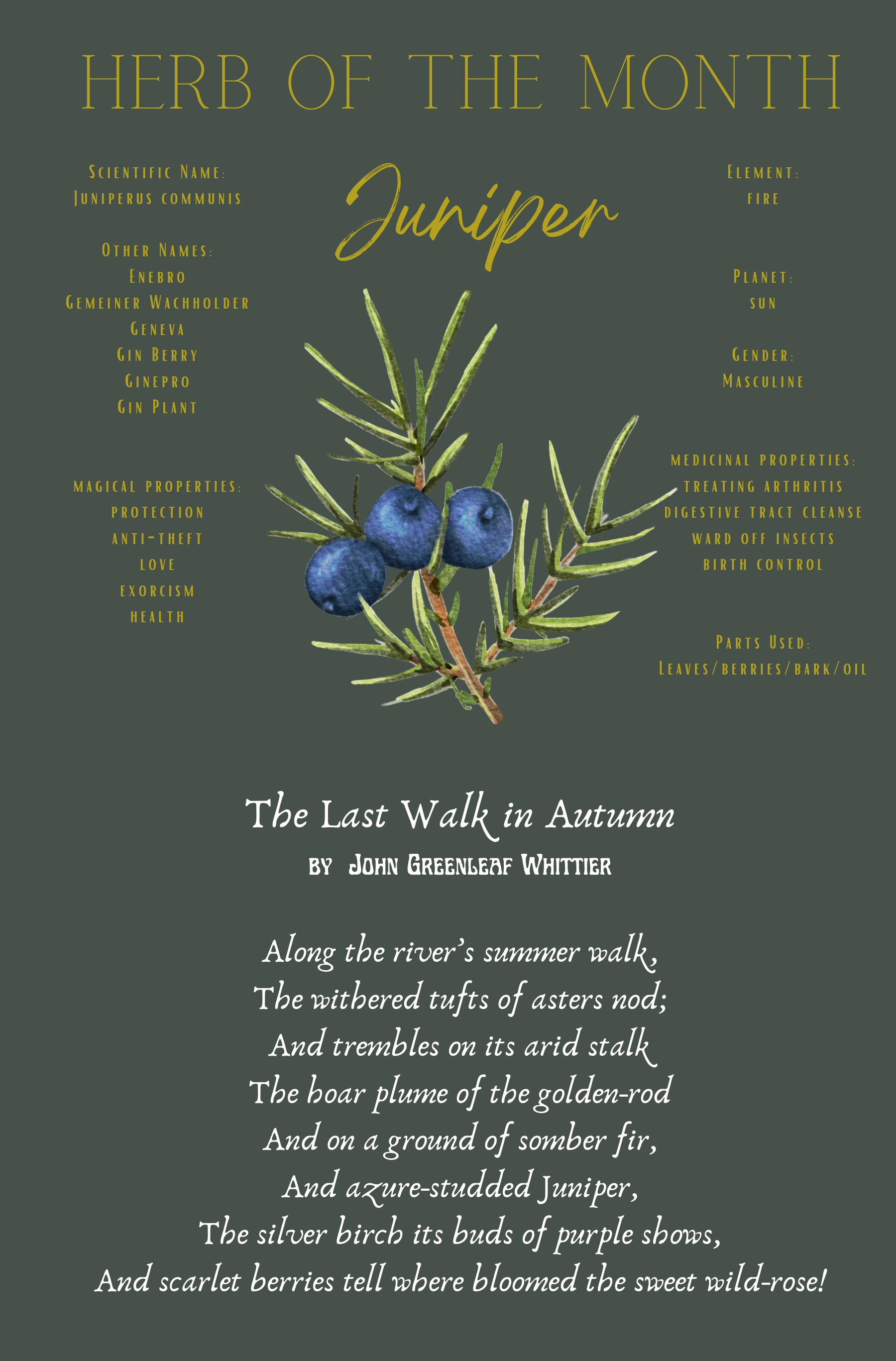
Juniper was likely one of the first magical herbs used by Mediterranean witches, as there are many folk magic remedies that include Juniper that have been passed down through the ages. It was used mainly in protection spells and was basically a witchy version of a home alarm system, since it was believed to protect against theft, many people would adorn their front doors or porch areas with it. It is commonly used in banishment magic, or in protection against dark magic.
Juniper berries were often added to love spells, rituals and potions. It was believed that they could increase “male potency”. A tincture made from Juniper berries, diluted and sprayed onto the bed might make a great love potion to help increase stamina during sexy time.
Juniper was thought to be the guardian of the dead, and that it would guard and nurture departed souls until they were ready to be reincarnated. So it was often planted atop graves for this reason.
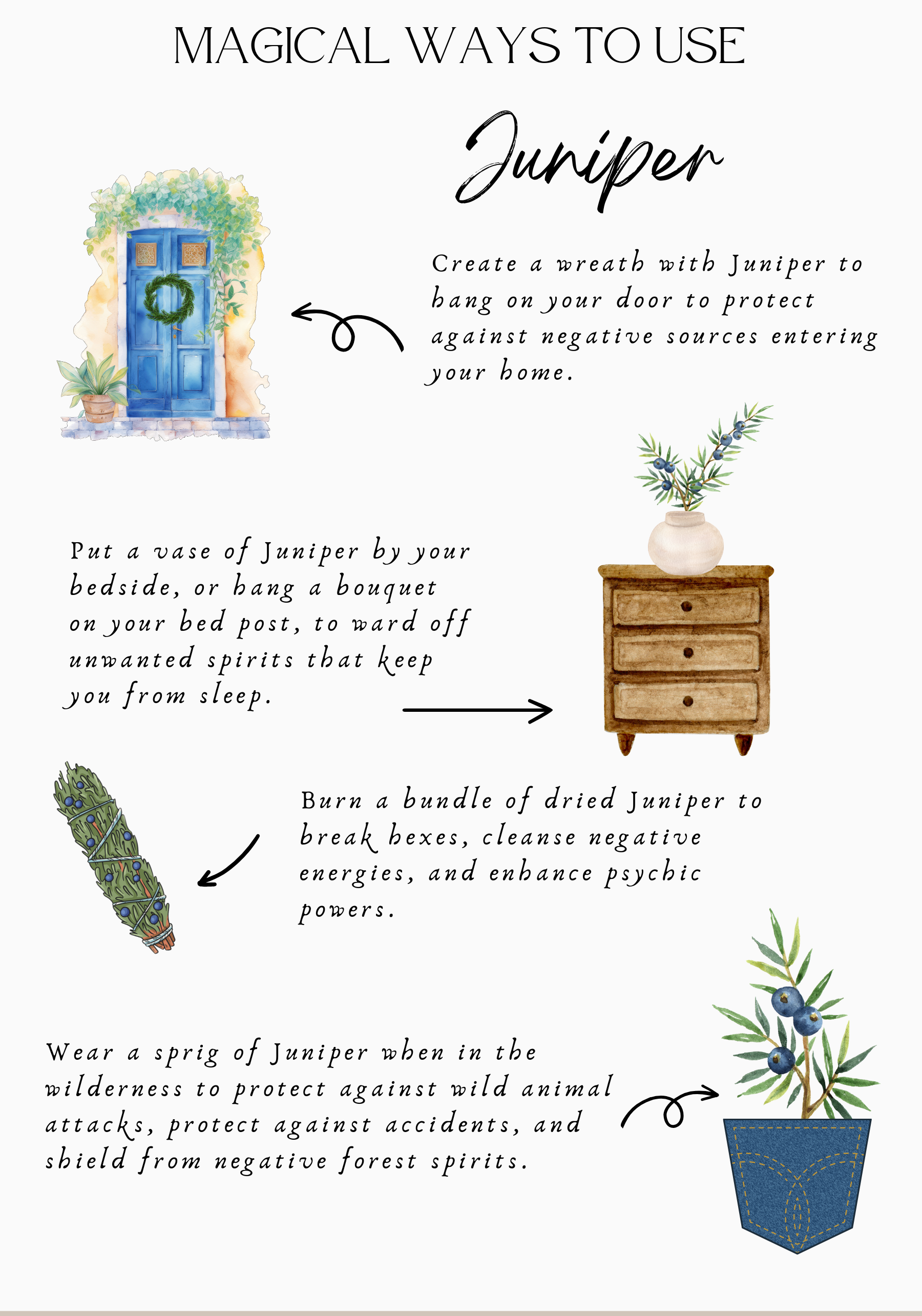
Here are some more magical ways to use Juniper:
Practical and Medicinal uses of Juniper
Historically, Juniper was used to fight infections and plagues. During the Black Plague it was burned in closed rooms to purify the air of disease. In the time of the Spanish Flu, Juniper oil would be sprayed into the air to prevent the disease from spreading. This proved to be quite beneficial, especially when paired with Lavender and Thyme.
Juniper berries were once used as a form of birth control. They were, and still are, used to treat arthritis and to detox the urinary tract.
Juniper berries are also one of the main aromatics in Gin and used in the distillation process.
People have used Juniper for cancer, diabetes, gas, indigestion, kidney stones, wound healing, and many other conditions.
DO NOT consume Juniper or Juniper berries without consulting a Doctor first! They can have many interactions with other medications, and consuming too much can be harmful.
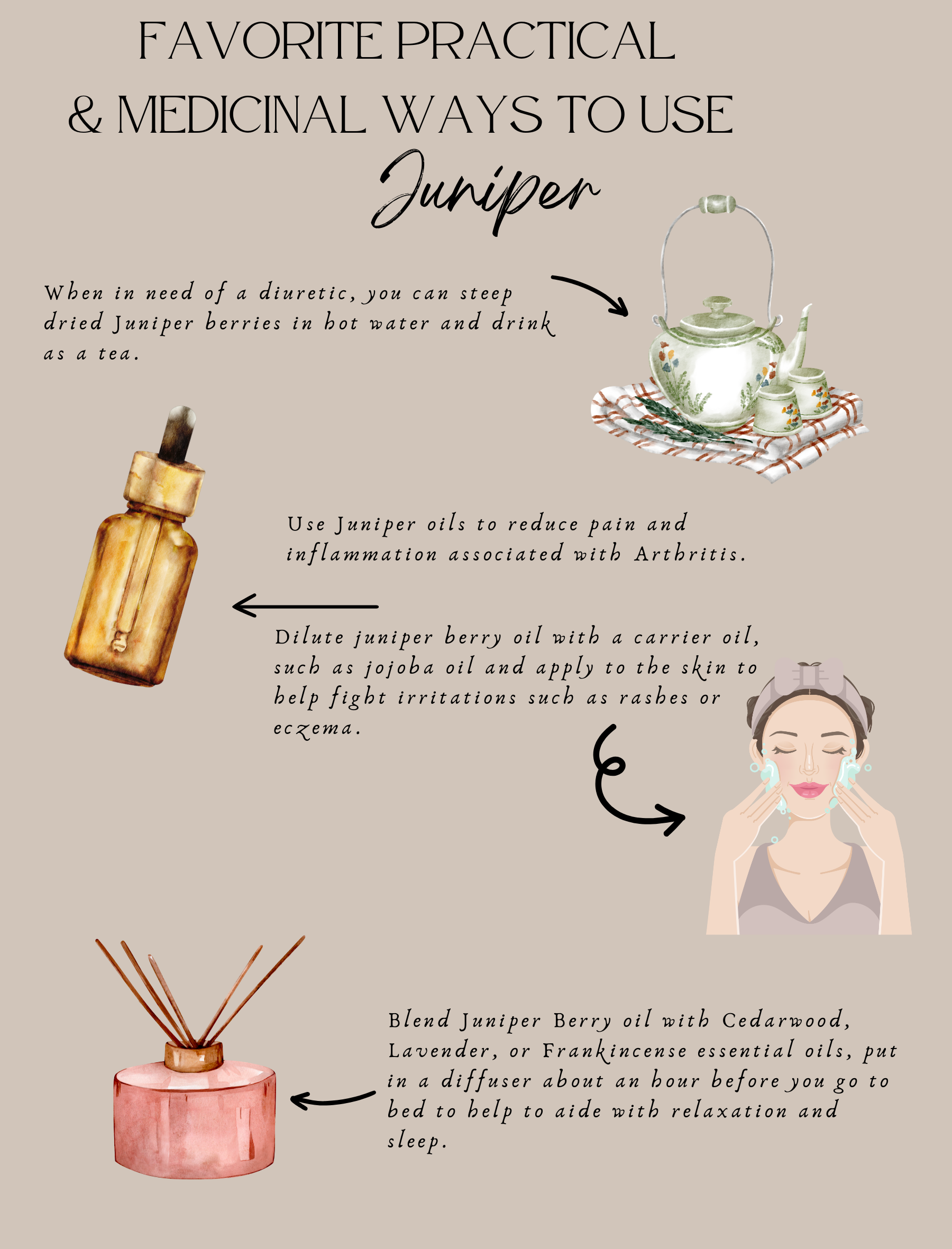
Here are some Juniper remedies practiced today:
One of the best things about Juniper, for me, is that it is easily found in my area. I think it’s important to use what grows in your area if you can. Not only is it more sustainably responsible, but there is something extra magical about using what is natural to your area. If you haven’t tried Juniper yet, we sell bundles in our shop, or better yet, gather your own if it’s in your backyard!
It’s February, and in a few short days it will be Valentine’s Day. I thought it would be good to promote a more “self love” vibe this Valentine’s Day rather than romance and that kind of relationship to the Holiday. After all, we are the most loving to others when we are taking care of ourselves first. And taking care of ourselves is the best example of self-love. Taking time to nurture our own needs, to give ourselves the attention and kindness we deserve, and to give thanks to our minds and bodies for housing and holding our spirits is not only essential to our well-being, but how we in turn treat those around us. We can love easier and better when we practice with ourselves!
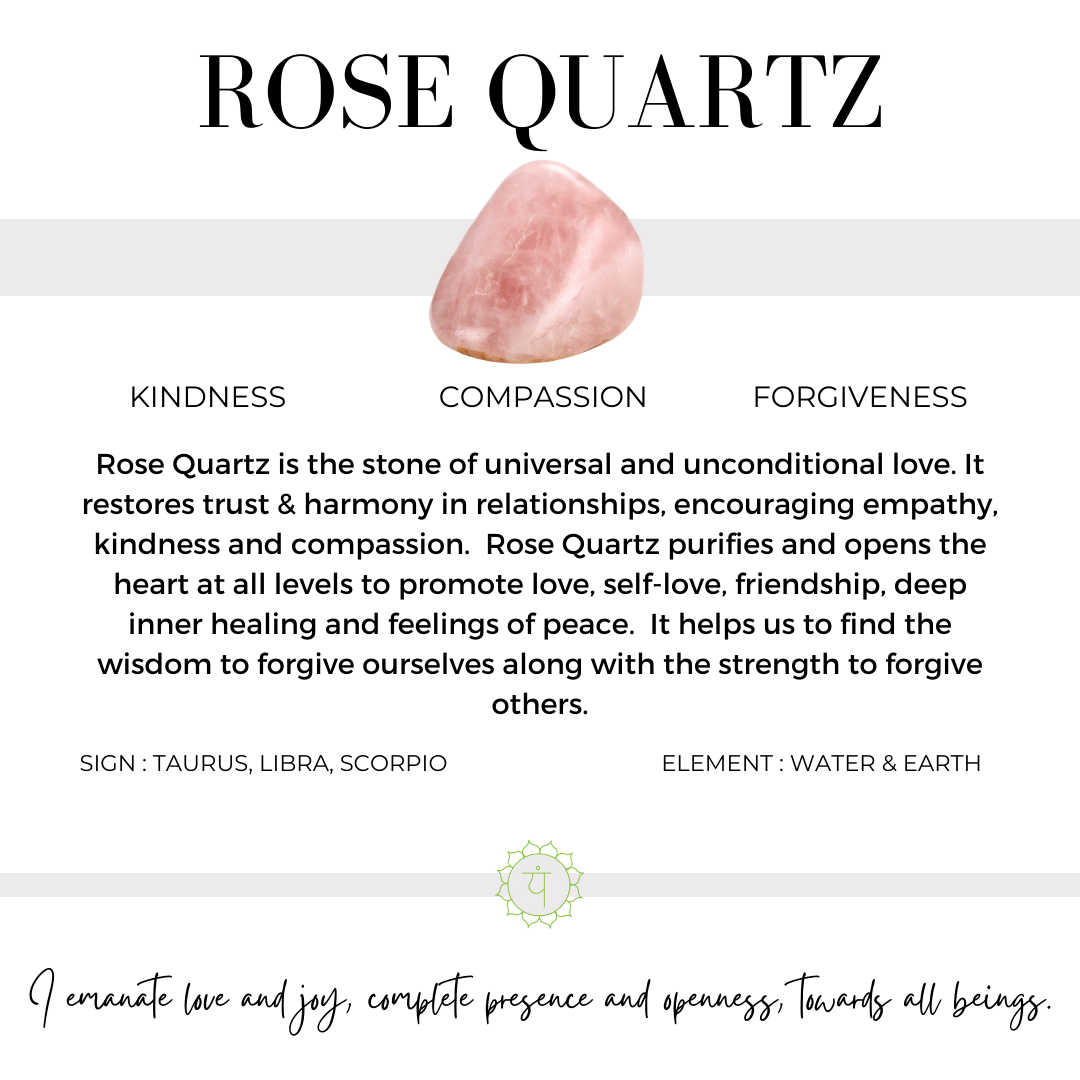
Rose Quartz is the stone of unconditional love, making it the perfect stone for all things love related. Self-love, friendship, family, and even romantic love. It promotes harmony and gives a sense of security, so carrying it around can feel like a warm hug.
If you are needing to work on any emotional healing, it’s a great stone to hold during meditations and workings centered around healing old emotional wounds, or releasing emotional trauma. If you are working on relationship issues in any capacity (self, friendship, romantic, family) it can help promote healing and peace, and bring in a sense of calm and understanding to the situation.
Rose Quartz is said to have some physical benefits as well. It is believed to help the heart and circulatory system. Also, it may aid in the repair of unhealthy skin cells, promoting healthier, glowing skin. Some believe it has the ability to release impurities in the body, creating a detoxifying effect so that the body can heal itself easier.
Rose Quartz is mined all over the world in places like Brazil, Madagascar, India, South Africa, Australia and the United States of America. Making it easily accessible and one of the most popular stones to have in a crystal collection. It’s usually one of the first stones collected, along with Amethyst, Citrine, and Clear Quartz. Paired with its awesome healing qualities, it’s a stone everyone should have in their personal collection!
It also makes a great gift, especially for Valentine’s Day, for friends and family and even partners. We have lots of heart shaped Rose Quartz carvings in the shop as well as bracelets, earrings, necklaces, towers, and tumbled stones.
And if you were looking for a more “spicy” stone for Valentine’s Day, try checking out Garnet. You can read more about it here. Pair the two together for a powerful combo for your lover that gives both tender romance AND fiery passion *wink*.
If you have been following this blog, you will have already read a bit about the four Celtic Fire Festivals, or “Greater Sabbats” of the Pagan “Wheel of the Year”. If you haven’t, you can read a bit more of that on this post, where I have broken it down for you. For the sake of not being too repetitive, I will let you go back to that post for more info on sabbats in general, and I’ll just glaze over it here before getting to the meat and bones of what Imbolc is.
We have already covered Samhain (Sow’n), and Lughnasadh and after this Imbolc post, we will be sure to cover Beltane on May 1st, as we prepare to move into the summer months.
Together, Samhain, Lughnasadh, Imbolc, and Beltane make the Greater Sabbats, with Ostara, Litha, Mabon and Yule making the “Lesser Sabbats” which mark the Solstices and Equinox’ of the year.
Imbolc is also known as Oimlec, Candelaria, and Lupercus. We know it to fall on February first, though, some Celtic traditions would say it falls on the second new moon after the preceding solstice or equinox. So you can celebrate Imbolc anytime between January 29th to February 3rd and still be fine. I will be celebrating on the 31st this year, as I am leaving town February 1st, and this is the best time for me to refresh my altar and connect to the energies and spirits associated with the bringing forth of spring.
Imbolc marks the halfway point through the dark half of the year, or what we know as the winter months. In old Britain and in much of Europe, they would have great bonfires known as “balefires” that were lit across the highest hilltops in support of the God as he made his way through the dark half of the year towards Beltane. Once there, the Goddess would take over until Samhain, where once again, the God would take back over and the wheel of the year would start anew.
These Sabbats were a way of welcoming all the seasons and cycles of the year, giving thanks, and petitioning for blessings for health, home, crops, and protection. Imbolc comes from the word i’mbolg which means “in the belly”, symbolizing the first stirrings of spring in the womb of Mother Earth, and all the new life that happens during the springtime such as lambing season.
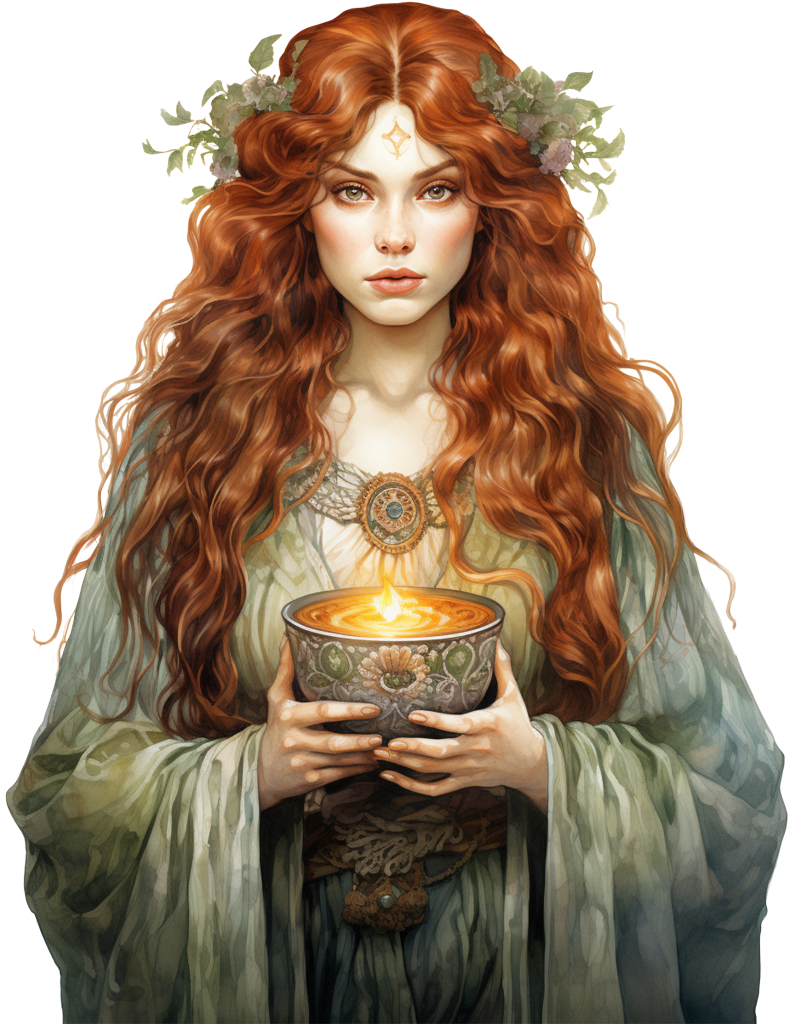
The Goddess Brigid
The Goddess Brigid, also known as Bridget, Bride, Brig, or Brid, has long been associated with Imbolc. There is a LOT of speculation and mystery around her and who she was and came to be. Some would say she is the Celtic version of Persephone (if you need a little info on Persephone, click here and read the fifth paragraph). Which totally makes sense given that she is celebrated during the time when we start to come out of our winter slumber and work our way into the season of spring.
Due to the fact that Ancient Celtic traditions weren’t written down, and were passed along through family lineage and often kept secret, we do not have all the answers we seek today about her, or even about many Celtic practices. We have just a little information here and there to go off of, and so, we are left to put the puzzle together ourselves and to fill in the gaps as we do research in order to make sense of things.
With that being said, the Goddess Brigid was thought to be a single Goddess by some, but also a Triple Goddess by others. As a Triple Goddess, she would inhabit the qualities of all women, in every cycle. She is known today as the Goddess of poetry, learning, healing, mid-wifery, and metal smithing. She was often called upon by soon-to-be mothers in the midst of child labour, for pain relief, and to ensure a safe birth.
The name Brigid means “fiery arrow” and it became a tradition around the 12th century to keep an eternal flame burning at her shrine in Kildare Ireland.
During the eve of Imbolc it was tradition to invite the Goddess Brigid into the home, asking for her blessing, and giving her offerings of flowers, shells, herbs, ribbons, and the traditional “corn dolly”, in return.
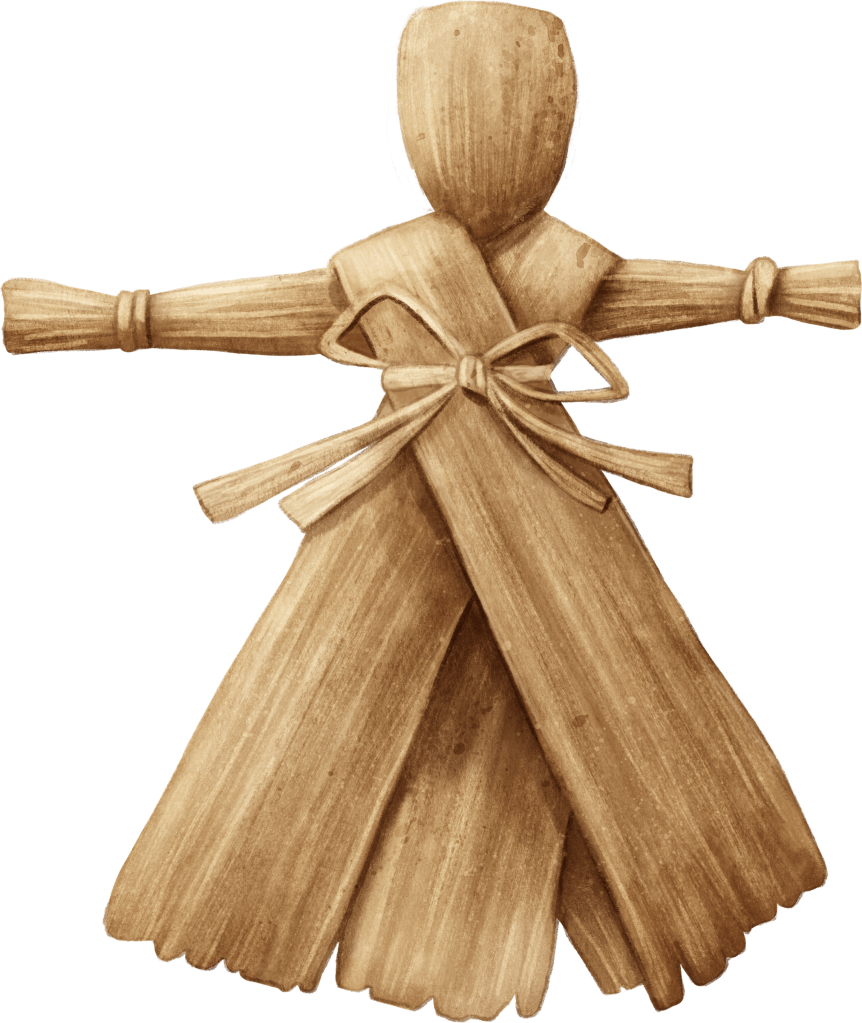
The Corn Dolly
The corn dolly is just as it sounds, a doll made from corn husk or the last sheaf of grain. There are many stories on how the corn dolly was used and what it represented, but I will try to stick mainly to its associations with Imbolc. It is thought to represent and honor the spirit of corn and grain, and it is said they were burned during Imbolc to bring about luck to the upcoming crops.
Another told tradition of the corn dolly, was where families would create a dolly, put it into a basket and take it house to house where the women of each household would welcome her in with a special ceremony, paying respect and giving offerings in return for her blessing upon their household.
Brigid’s Cross
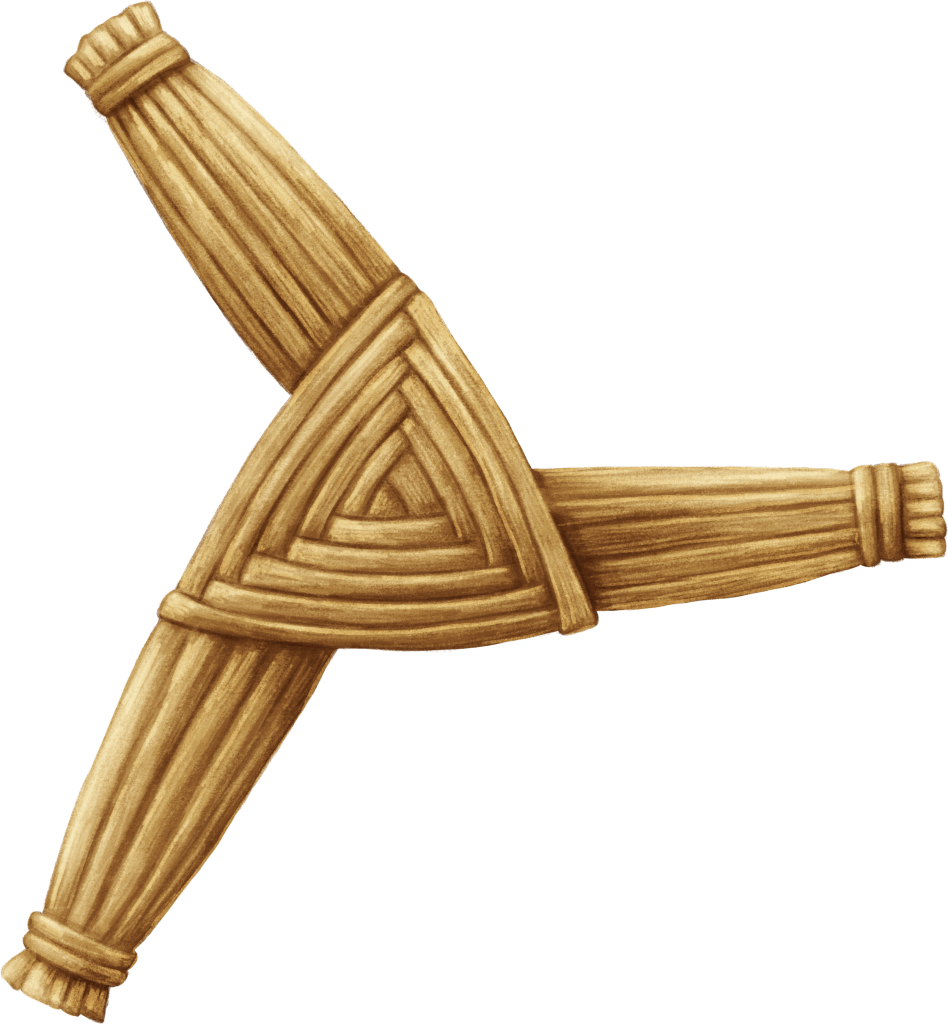
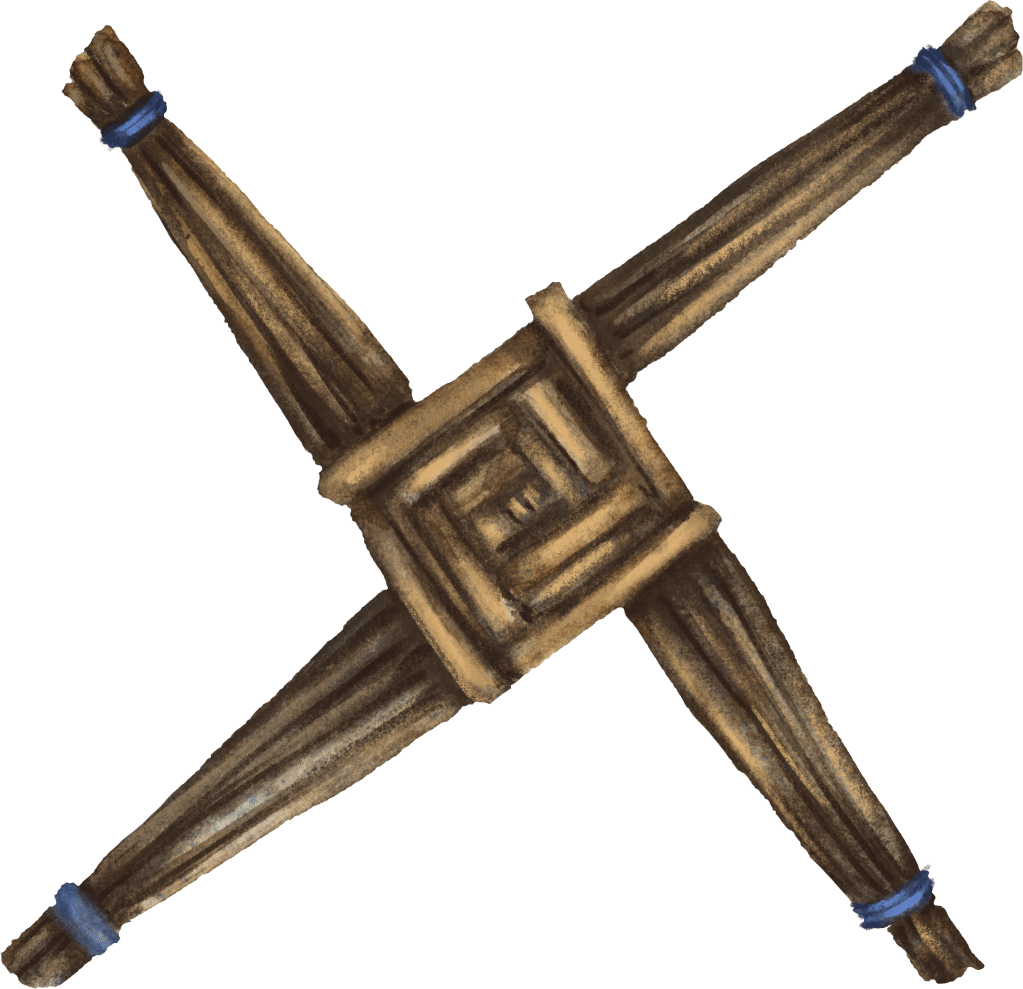
A Brigid’s cross became a sort of talisman associated with Imbolc, and was traditionally created out of Rushes (a long grass-like leaf with unjointed stems) then hung above the door or a window, as a symbol of protection, hope and renewal.
What I can tell from my research, is that the oldest versions had three sides, unlike the one’s we see today with four sides. This most likely became the new normal when Imbolc was “transformed” into the Christianized version called Candlemas, and it was probably made to represent a more traditionally “Christian” cross. I will speak more about this later on.
Now days we can make Brigid’s crosses out of whatever is grown in our area that has a similar shape to the traditionally used Rushes. I live in the desert and have made them out of Palm leaf strips, and I recently saw one made from Yucca leaves.
Serpents were traditionally associated with creativity and inspiration, and in Celtic mythology, Brigid was associated with a hibernating serpent that would awaken at Imbolc.
Colors
White, silver, green, yellow, and sky blue.
Crystals
Garnet, Moonstone, Amethyst, Bloodstone, Selenite, and Rose Quartz.
The Goddess Brigid, St Brigid, Bastet, Eros, Aphrodite, Hestia, Aradia, Aenghus Og, Ceres, Cerridwen, Faunus, Gaia, Pan, Venus, and Vesta.
How to Celebrate Imbolc Today
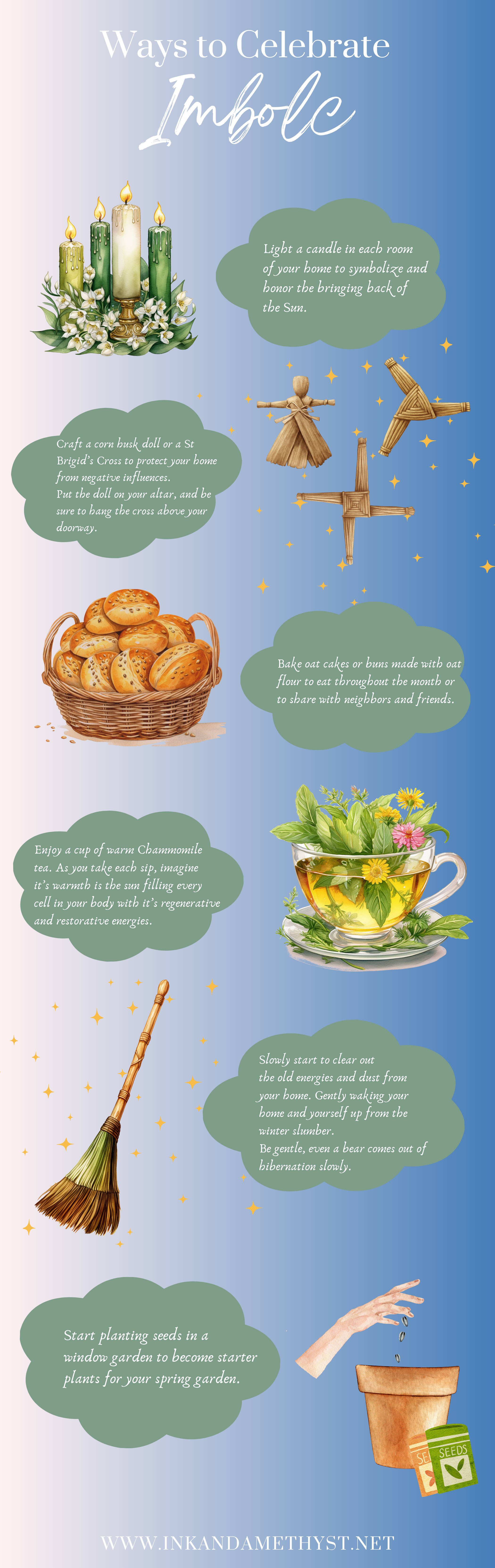
You don’t have to light big balefires, or pass around a corn dolly to celebrate Imbolc today. I always change my altar out for each season or Sabbat, and place offerings like some of the things listed above, and say prayer for blessings upon my household and those I love. Below are some simple yet effective ways you could celebrate if you want to be a part of honoring this season too!
The Christianized Version and Brief History
It is always interesting to learn about the Christianized versions of ancient Sabbats that have become modern Holidays and celebrations.
With Lughnasadh we have the Christianized version of Lammas (Loaf Mass). With Samhain we have “All Saints Day” and “All Souls Day”. With Ostara/ Easter, Christmas/Yule, Beltane/May Day, and Litha/The feast of St John the Baptist. It is understood that when the Roman Emperor Constantine was trying to convert the masses (in a political move) to Christianity, he was able to convert many who didn’t want to give up the old celebrations, by transferring them over into a Christianized version of the same thing.
The Christianized version of Imbolc is Candlemas. This Holiday is observed on February 2nd, where Roman Catholics and Eastern Orthodox celebrate it as the Feast of the Presentation of Jesus at the Temple. It commemorates a story found in Luke 2:22-40, where Joseph and Mary take the baby Jesus to the Temple in Jerusalem. During this visit, the baby Jesus was given a blessing in which he was declared a “light” of hope to humanity.
Candlemas is a time to welcome in “the light” and is celebrated by the blessing, anointing, and lighting of candles, much like the Pagan Holiday of Imbolc. They are known today as two completely separate Holidays, though we can’t deny their similarities.
However you choose to celebrate, take a moment to connect with what resonates most with YOU. Connect to the cyclic nature of earth, and your maker, and whatever you feel inspired to that is for your greatest and highest good, and for the greatest and highest good of all. Bless you, and blessed be!
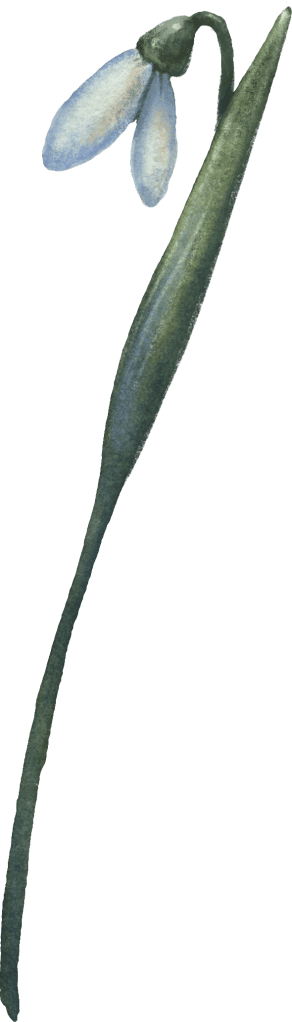
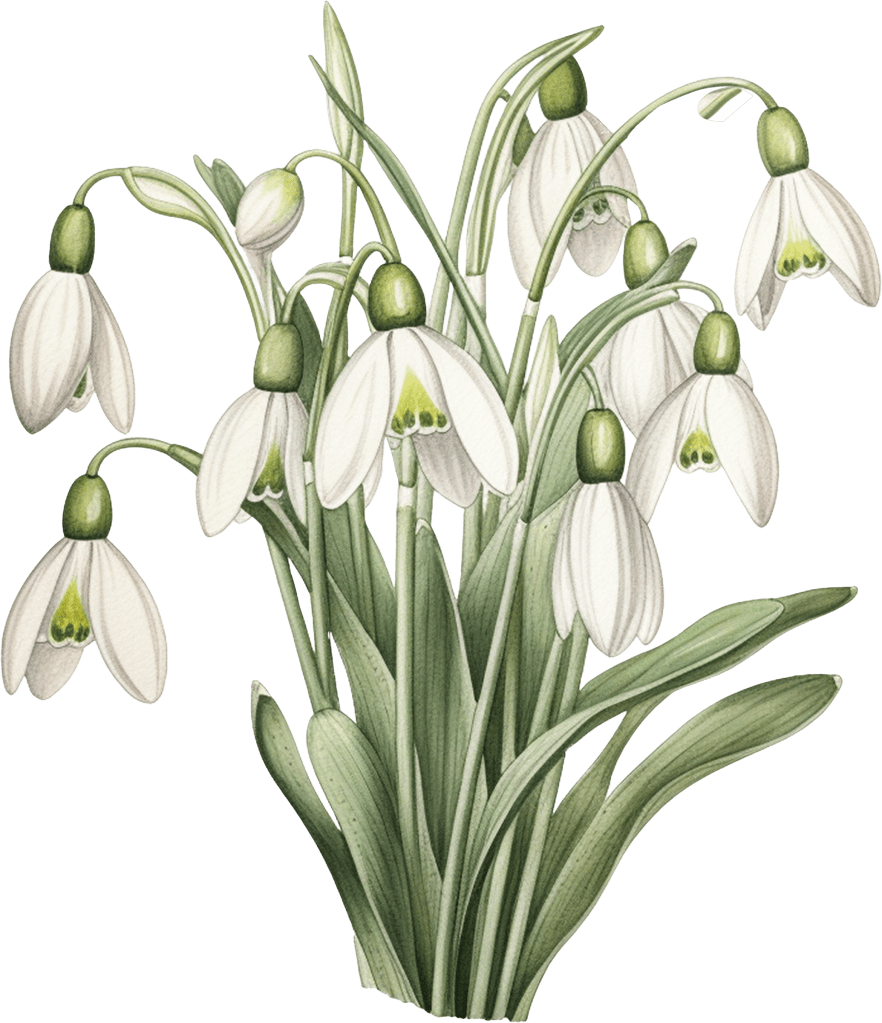
This month we are highlighting the Snowdrop flower. I must admit, I didn’t know much about this flower because it is not native to my area. (I can’t wait to highlight some of the flowers that are.) But it is a flower traditionally used in Imbolc celebrations and its meaning and correspondences go with this time of year perfectly.
Let’s start with a little basics about the Snowdrop-
The Snowdrop (Scientific name: Galanthus Nivalis) is a flower originally native to Europe and the Middle East, more specifically, regions like the Caucasus, Eastern Turkey, Northern Iraq, and Western Iran. The first recorded cultivation of the Snowdrop flower was in England in the 16th Century, but it is argued that they were brought over from either the Romans, or Norman monks much earlier than that.
Snowdrops were often one of the first blossoms to bloom at the end of winter, popping up through the blanket of snow and sending a sign that warm days were on their way. So naturally it was considered a flower of “Hope and New Beginnings”. The fact that the flowers survived the harshness of winter gave it, also, the association to “Resilience”. They are a hardy perennial, meaning they come back year after year, which may also contribute to their “Resilience” association.
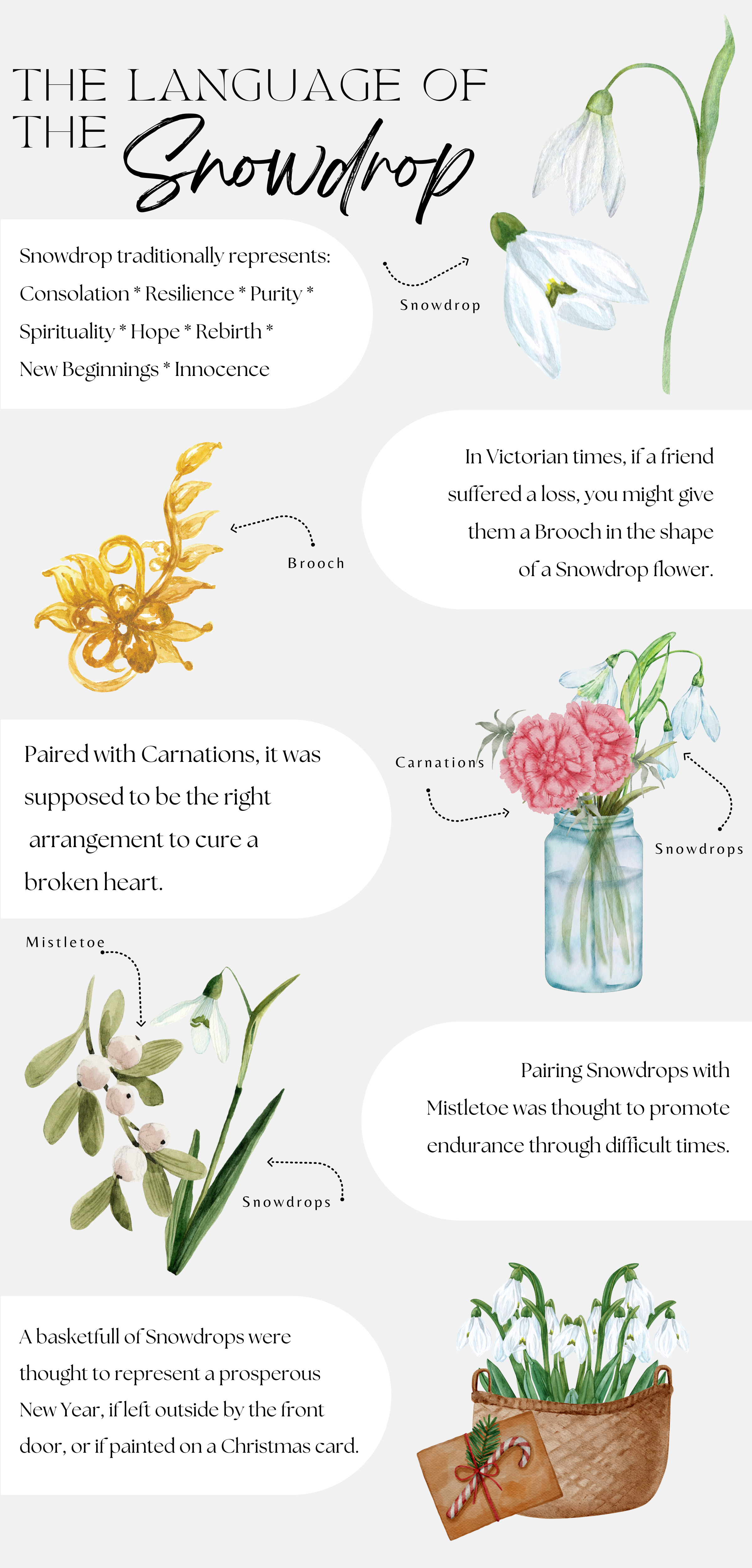
If you have read any of my previous “Flower of the Month” posts, you know that I have a small fascination with the Victorian Language of Flowers. This is basically a way of communication created by upper class Victorian society that involves giving meanings to flowers to convey feelings and messages. By sending certain flowers to people for specific situations, you were saying something. On the graphic below, you can see some examples of how the Snowdrop was used to communicate in this way.
The Victorian Language of Flowers-
While the graphic above shows most of the happier or lighter associations of the Snowdrop, there were definitely some negative ones too. It was thought among some to be a bad omen to bring Snowdrops into the home, almost as if it was a harbinger of death, yikes! But having Snowdrops in the garden were a welcome and happy thing, and even associated with higher status, as it was a much sought after flower during the time.
As mentioned above, I chose to highlight Snowdrop because of it’s association with Imbolc and the this particular season of the year. Imbolc is the halfway point from winter to spring, and so the Snowdrop gives us hope that any day, we can start seeing signs of spring and warmth again, and the return of the sun!
Be sure to check back here soon for a post on Imbolc, and how you can honor and celebrate the bringing in of the next season. Until then, be well!
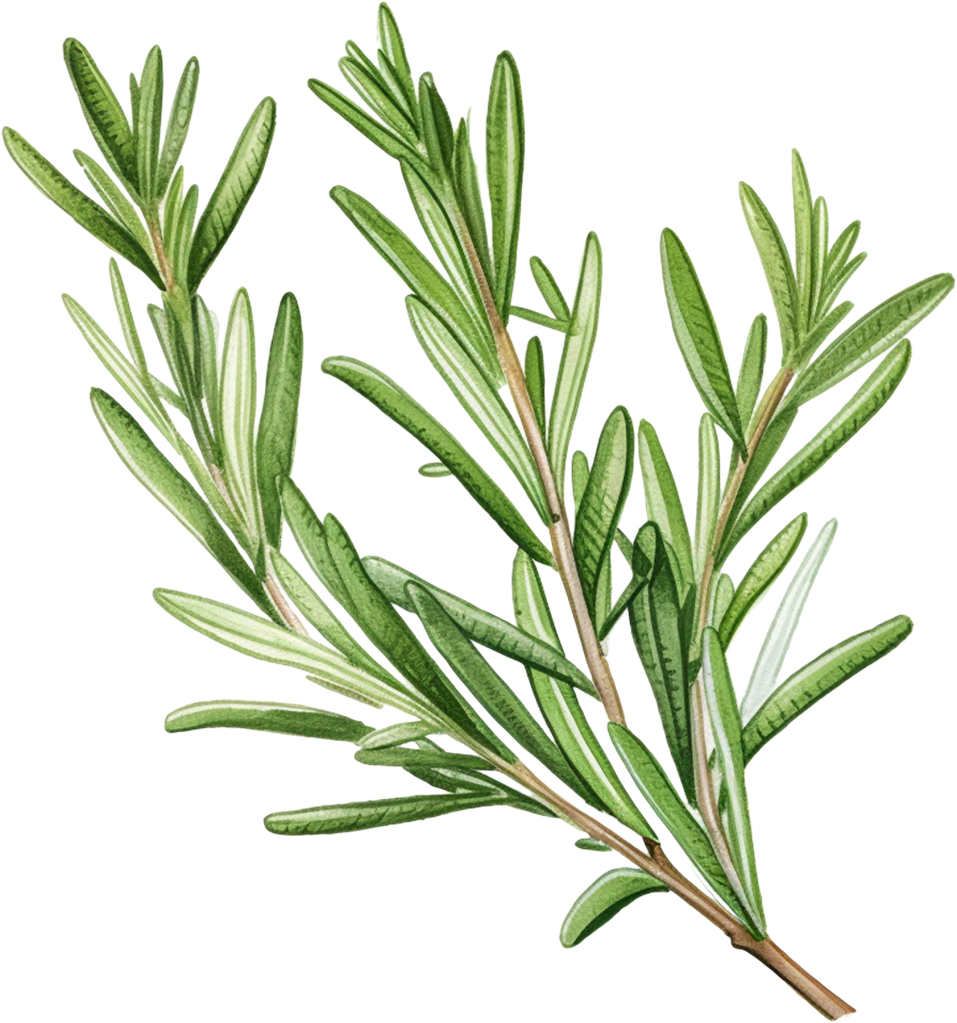
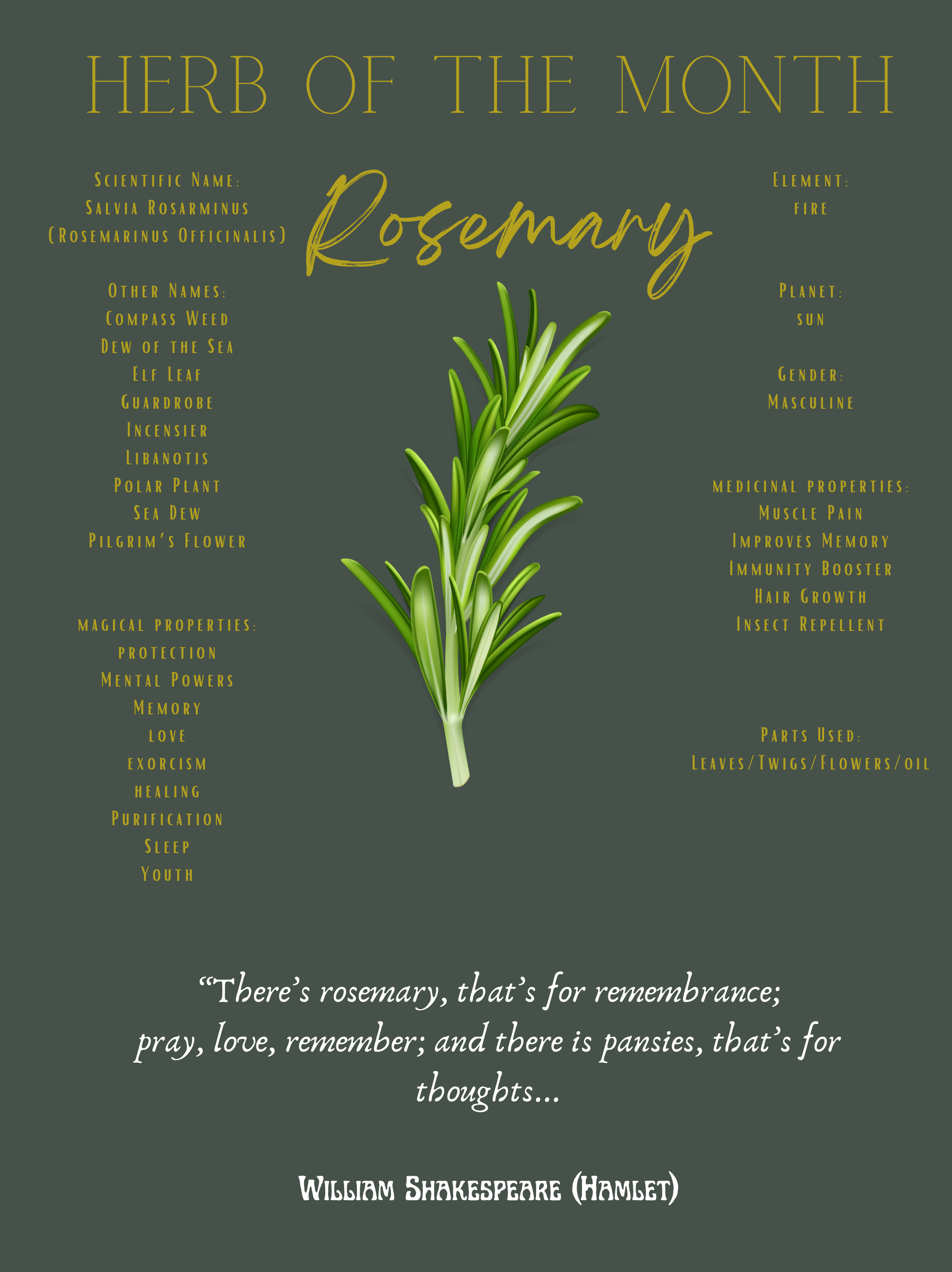
The first herb I want to highlight for 2025 is Rosemary. It is hands down one of my most favorite herbs ever. I work with it weekly, maybe even daily. It’s one of the plants I have a deep connection to personally, and it has become a dear friend.
Every single day I greet my Rosemary bush as I am leaving or entering my home. He sits proudly and protectively on my front step, greeting and welcoming those with good intention into our sacred space, and repelling all that may be ill-willed.
Rosemary is known to brighten the mood and relieve anxiety, stress and depression. So it’s no wonder my daily dose of happiness starts when I gently and carefully rub my hands across the stalks of my Rosemary plant as I am telling it “hello dear one”. Followed by a deep inhale of the pungent, yet beautiful, oils that are transferred onto my hand in our loving exchange.
I love all my plants like this, but my Rosemary plant and I have a special bond for sure. (Yes, this may make me a weirdo, but as an animist, it’s pretty normal!)
I work with Rosemary in many of my spiritual crafts as well as in my everyday household.
Let’s talk about the magical uses first-
For years I have used Rosemary to cleanse my hands before working on my altar or before creating magical workings. I have an oil blend of Rosemary oil and Jojoba oil that I have blessed and I just apply a few drops on my hands and rub my hands together (I do this in a particular way and say a blessing that I will not share at this time, but you could make your own blessing that is unique to you). This just helps clear any negative energy from my hands so that it doesn’t transfer onto the things I create. It’s an added layer of intention and blessing that feels good to me, and I particularly love doing this before creating items for the shop (Ink & Amethyst).
Rosemary is my favorite type of smoke cleanse! Yes, even more than White Sage! Plus, it’s more sustainable, and easier to source ethically. It feels right, and clearing my home with it brings in a sense of peace and comfort. Perhaps that is because it is one of the herbs my Celtic ancestors used in their sacred Saining rituals. (My close second is Juniper followed by Cedar, then Mugwort and Lavender.) But Rosemary is always my first choice. I highly recommend you try it, especially if you have been stuck on using White Sage and Palo Santo, as it would be a great alternative, and healthier for our environment.
I use Rosemary in so many ways, it would take too long to list them all here, so I will just tell you one more magical way I use it often, before telling you some of the more practical ways I use it. I have, in my opinion, perfected a long passed down recipe for Black Salt, and one of the important ingredients is Rosemary. Not only the ash from months of Saining ritual, but also hand-picked, dried, and ground from the plant(s) I grow myself. In my personal mix for my home apothecary I even put in a couple drops of Rosemary oil. But I leave the oil out for the shop’s apothecary to help keep it more shelf-stable. So if you make your own Black Salt, it would be a great ingredient to add, or, if you purchase from me over at Ink & Amethyst, you can add a couple drops of Rosemary oil if you would like an extra kick.
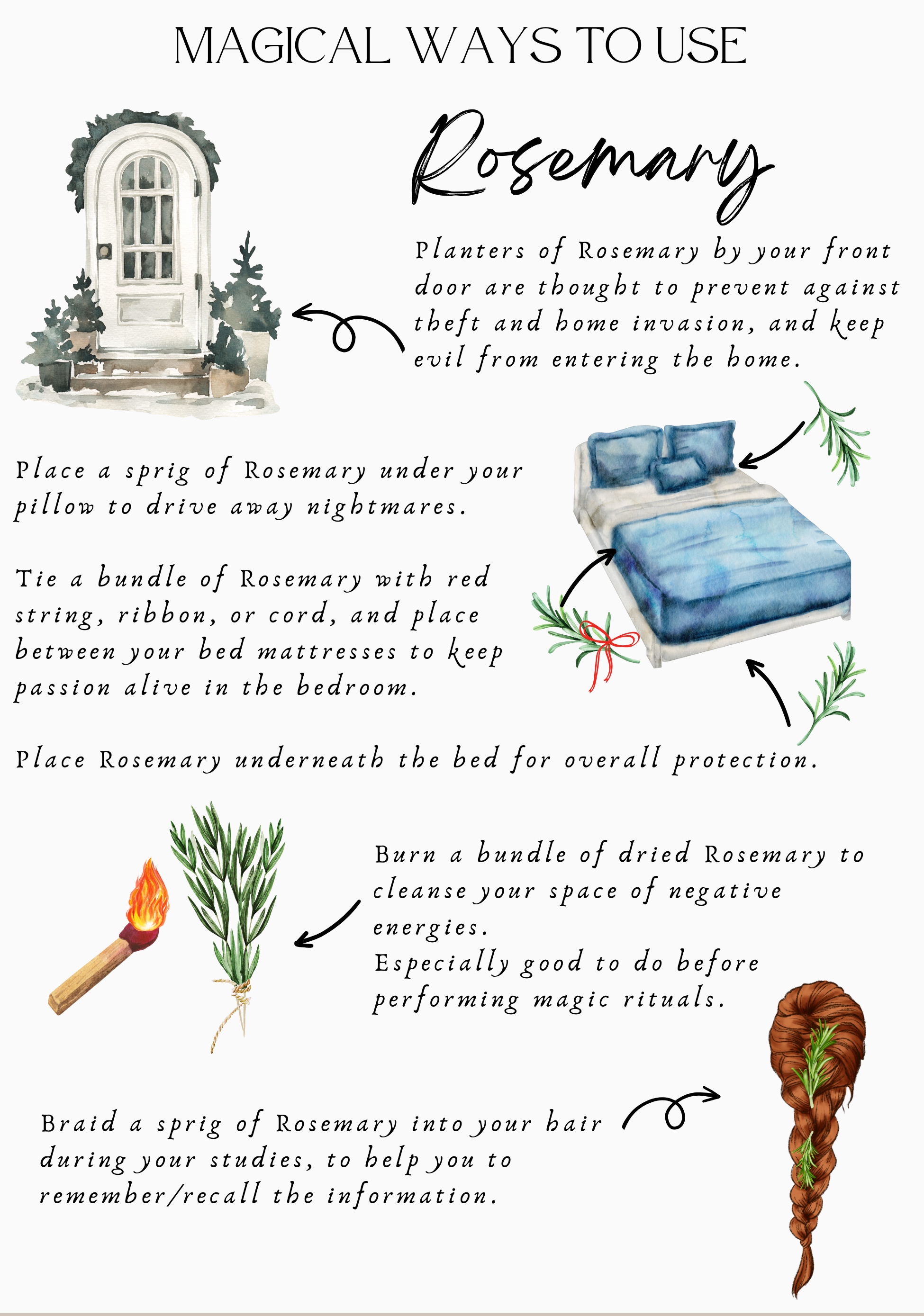
Here are a few more magical ways to use Rosemary, some are as old as Ancient Greece and Rome!
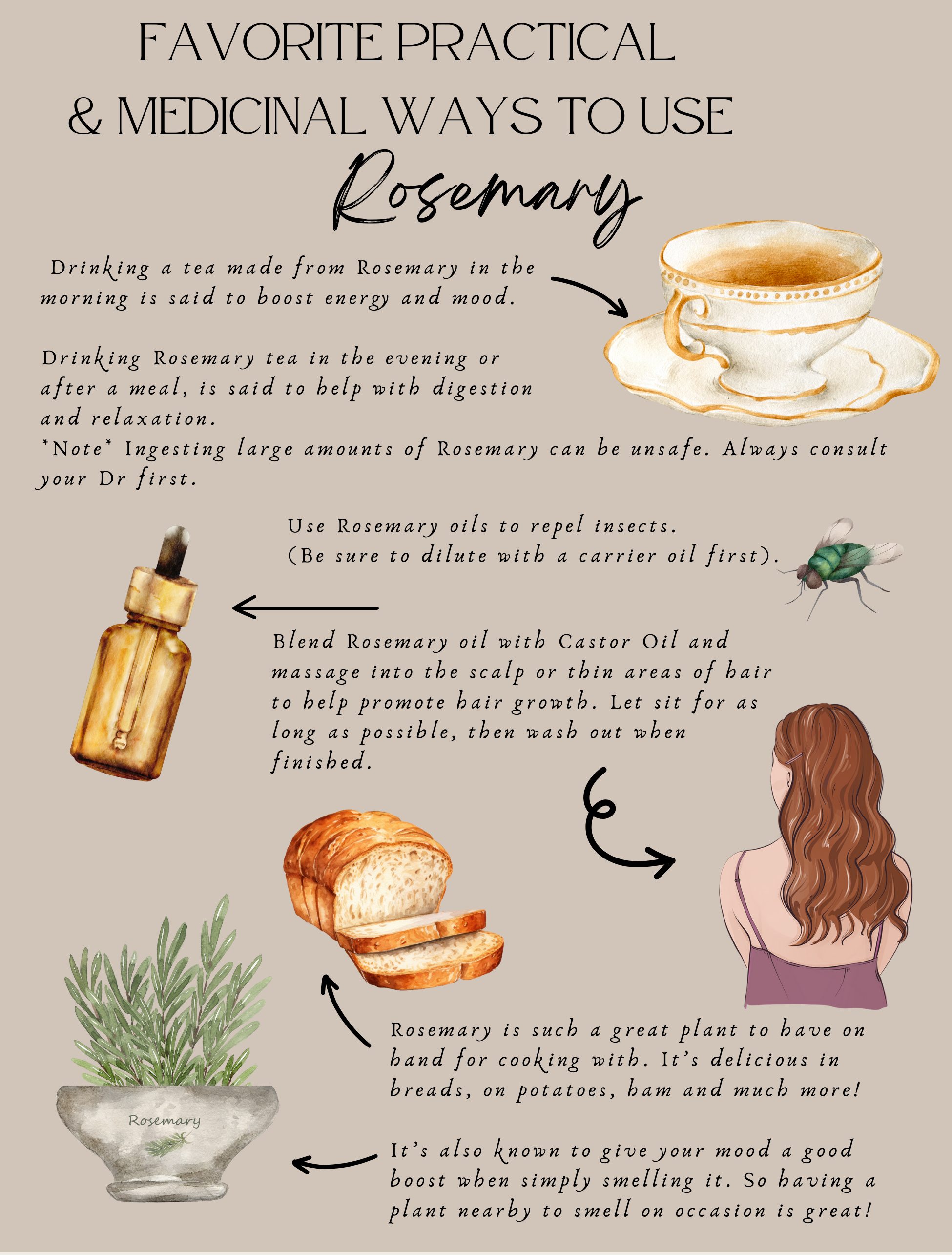
Practical & Medicinal Rosemary Uses
Some of the best ways to use Rosemary are simply in food. It’s delicious in so many things, potatoes, breads, and meats are among my favorites. If you are into kitchen witchery, it’s a double bonus! Not only will you be infusing your foods with medicine for the body, but medicine for the soul too.
As someone who has type 2 diabetes in the family, I try to make a habit of drinking a couple cups of Rosemary tea each week. Compounds in Rosemary tea, like carnosic acid and rosmarinic acid, may have insulin-like effects on blood sugar. Rosemary tea may slow down how quickly sugar is absorbed in the gut, which can help prevent blood sugar spikes after eating and may help increase insulin sensitivity, which can help regulate blood sugar levels. It also has many other benefits as well (see chart below) **NOTE** Over consuming Rosemary can be dangerous, and Rosemary tea should never take the place of medicine. Consult your Dr or licensed Herbalist first.
Almost 15 years ago, I had to have a complete hysterectomy and one of the worst side effects for me personally has been hair loss. Over the years I have tried many things to promote hair growth, but nothing has seemed to work. About a year ago I found a recipe for hair growth oil and started using it a few times a month. While I wish I could say it has given me a miraculous hair growth…(I can’t). I can say for sure, that it has helped overall. I have new growth coming in where the bald patches are, and my normal growth is even fuller. If only I could remember to make time to do this weekly, I think it could be even more beneficial. The concoction is a simple mix of Rosemary and Castor oil. I plan to make and test out a Rosemary shampoo and conditioner this year as well.
Earlier, under the “magical uses” section of this post, I talked about smoke cleansing with Rosemary. Well there are practical/medicinal benefits of smoke cleansing with Rosemary to go along with the spiritual ones. Rosemary has antibacterial and purifying benefits. So it can help heal certain illness. In ancient times, they would put Rosemary around hospitals and in bedrooms of sick people to get rid of germs. So if you have had that crud going around lately, you may want to burn some Rosemary to get rid of any residual germs lurking around the house.
The final “practical use” I have for Rosemary is so simple, it might be silly to mention. But it’s almost everyday that I do it, so I feel I should. As I mentioned earlier, I take the time to smell my Rosemary plant daily. It’s such a great herb to use for aromatherapy, as it is mood boosting and promotes feelings of wellness. So if you have a Rosemary plant, you can do what I often do, and snip a little sprig and put it in your pocket. Pull it out and sniff it throughout the day as you feel you need to. Simple, but so effective.
Here are a few more practical ways to use Rosemary:
A couple of fun old Folk Magic mentions that use Rosemary :
If you store Rosemary next to other herbs, it will cleanse and purify them.
In old Ireland it was hung above children’s beds to prevent them being taken by faeries and exchanged for a changeling.
Placing Rosemary on the Gravestone of a loved one ensured their spirit they would never be forgotten.
Smelling Rosemary often was thought to preserve youthfulness.
Burning Rosemary on charcoal and smelling its smoke is said to give you knowledge or answer a question.
Rosemary is used in exorcism rituals in many cultures.
Rosemary is known to help with dream recall.
If you come back in a few days, I will have a post up about Imbolc, and Rosemary is one of the Herbs associated with and used for this sacred Sabbat. So be sure to check back for info there too!
In the meantime, I hope you find a use for Rosemary in your practice or everyday life that brings you as much joy as it does me!
It’s January 2025! I managed to go a whole year without posting here on the blog. (sorry!) As you probably can imagine, Holiday season for a small business can be pretty crazy. So dropping off after October 2023 might not have been too surprising. But the fact that I didn’t come back at ALL in 2024… well, I didn’t intend it to be so.
After the Holiday rush, I was exhausted and my projected year, astrologically and otherwise, seemed to evolve around rest and respite. Not something that’s easy to do as a business owner… so I put new projects on the back-burner and made a list of the most important things vs things I could let go of for the time being. Can you guess which list the blog made? haha
Anyhow, I intend to be back this year! I even have a couple months of content ready to go. I am geared up and ready for new exciting things and bringing back old ones that we have missed this past year, like the blog. Let’s hope the fire doesn’t wear off anytime soon!
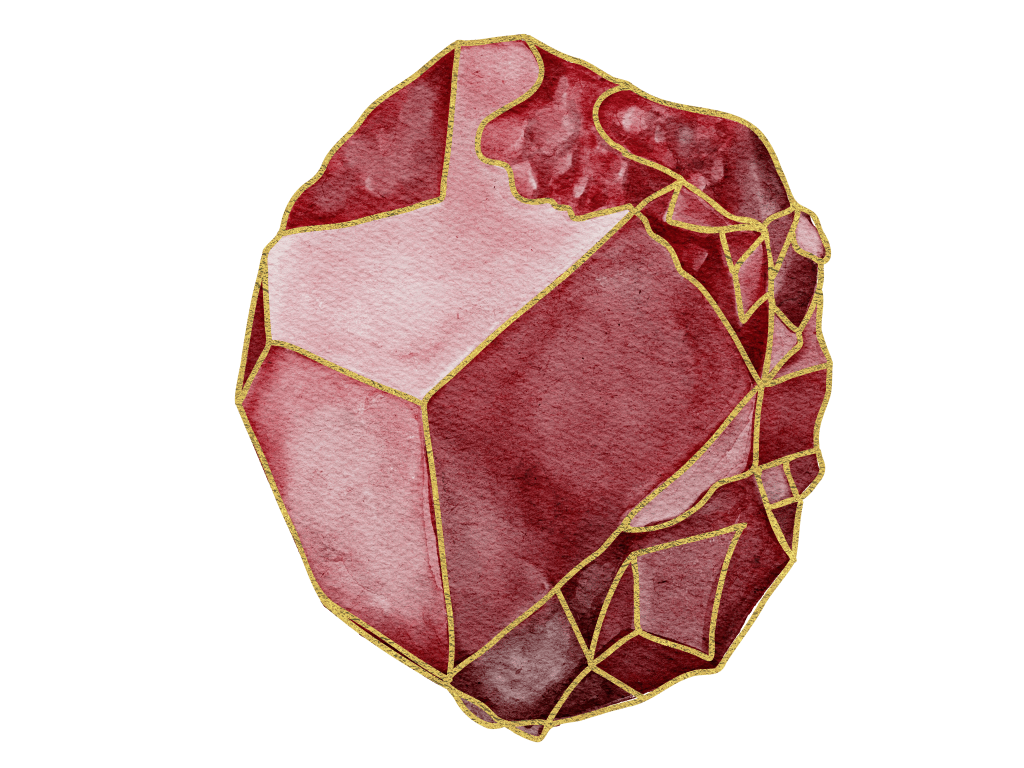
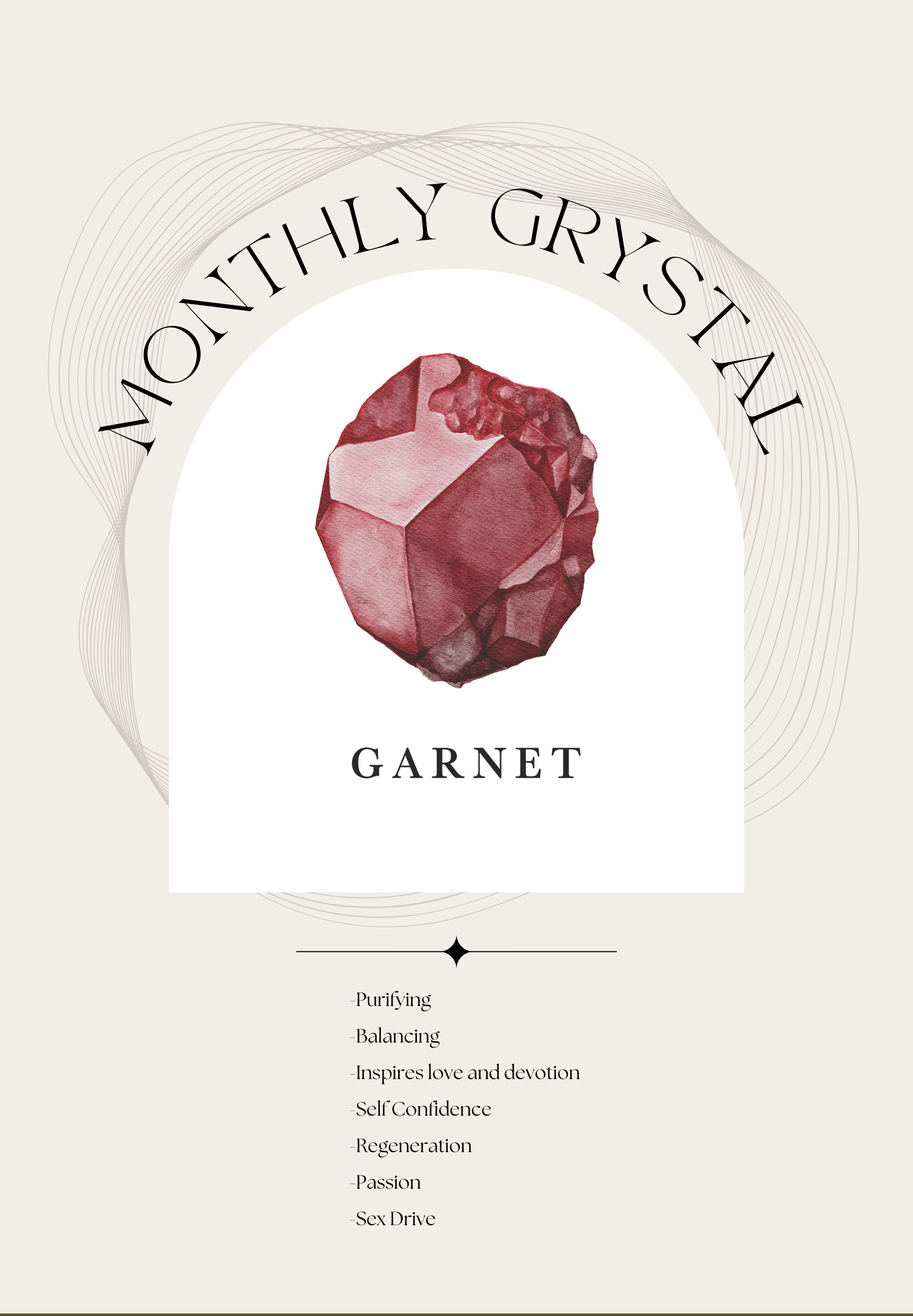
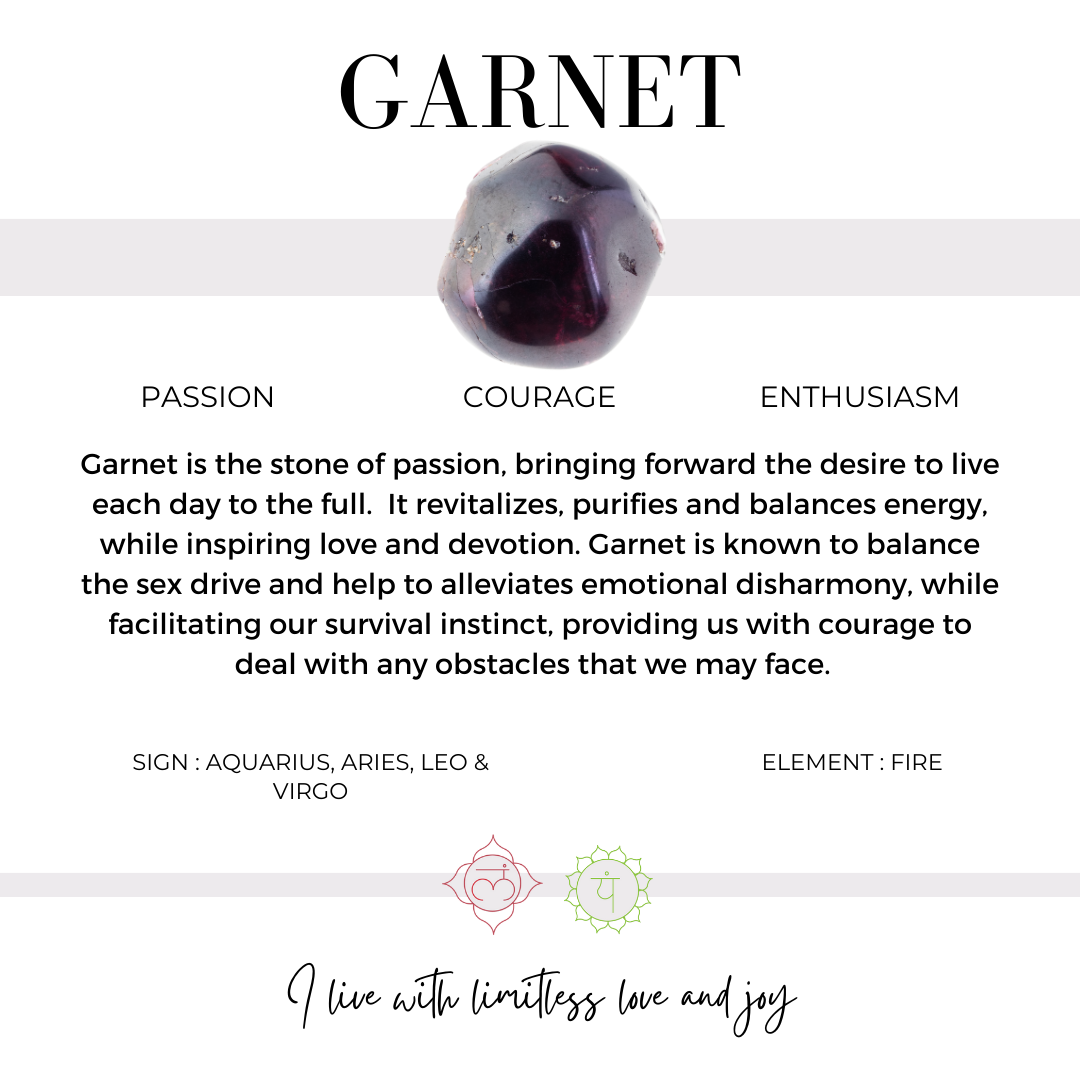
So let’s get to it. This January’s crystal of the month is….Garnet! Yes, it’s the traditional January birthstone. Yes, choosing it was a little lazy on my part, but after a little more research, it actually ended up being (what I think is) a good fit for this month all-around. Let me tell you why!
Did you know Garnet is known as the “Persephone stone”? If you know the story, it will make sense. The Greek myth is where Demeter, the Goddess of the flowers, was teaching her daughter Persephone how to care for the flowers when she was noticed and kidnapped by Hades, the God of the Underworld. Demeter was so upset that her daughter was taken, that she stopped caring for flowers and crops across Greece and this concerned the main guy in charge, the God Zues. Zues then told Hades to allow Persephone to leave the Underworld. Hades told him he would allow her to leave if she hadn’t eaten any of the food he had given her. Well, if you know anything about the Greek Gods, they were tricky tricky and Hades was no exception. He had given Persephone lots of food that she refused to eat in protest, but he had also included something she had never had before. A pomegranate. A beautiful, delicious, rare and intriguing pomegranate. By the time Zues had arrived to barter for her return, she had already consumed six tiny seeds of the pomegranate, thus creating a new deal that allowed her to stay with Hades six months of the year, and with her mother Demeter the other six months. And thus the myth of why we have seasons was born! During the spring, Demeter gets her daughter back and together they care for the crops and the flowers, and at the end of the summer, Hades comes for Persephone and things slowly die off and become the Fall, and then the Winter, until she returns again and we have Spring.
Aside from that fun little mythology bit, the Garnet has some actual helpful qualities too. It is a highly uplifting stone, and as we are deep within the drudges of winter, we can certainly use a little “pick me up”. With its rich colors and warming glow you really can’t help but feel supported and nurtured by all its amazing healing properties such as its ability to help regenerate the nervous system. This is something we can all use after depleting ourselves in the previous month’s hustle and bustle.
It is also a great grounding stone, connecting to our root chakra. Which comes in handy when it may be too cold to get outside and ground in the earth. Meditating with Garnet, and wearing it in the winter can help to keep you from getting too inside your head when you are cooped up inside.
And lastly, especially since this first January post is happening in the middle of the month, we can carry this stone into February where it makes a great stone to put into a collection of “love stones”, for your Valentine’s escapades. That’s because it’s good for “sexxy time”. Yes! Garnet is said to increase sex drive and libido, and also for inspiring romance. Put that by your bedside table if ya know what I mean 😉 (Or don’t, if that’s not your cup of tea, ha!)
And here’s the part where I tell you about all the awesome Garnet we have in the shop for you to purchase. I loooooove me some Garnet jewelry. It’s seriously one of my favorite stones. And I have several Garnet jewelry pieces that are gorgeous! We have some pomegranate seed shaped Garnet earrings and necklaces, some with gold plated pomegranate charms. We have some super sweet heart shaped garnet necklaces in both gold and silver toned stainless steel chains. We have Garnet stud earrings set in 925 silver and some lovely tear shaped garnet dangle earrings and matching necklaces.
And if jewelry isn’t your thing, we have raw tumbled garnet pocket stones, and a couple 3-4 inch Garnet towers. The pocket stones are a perfect sized for carrying around, and the towers would be perfect for that bedside table 😉
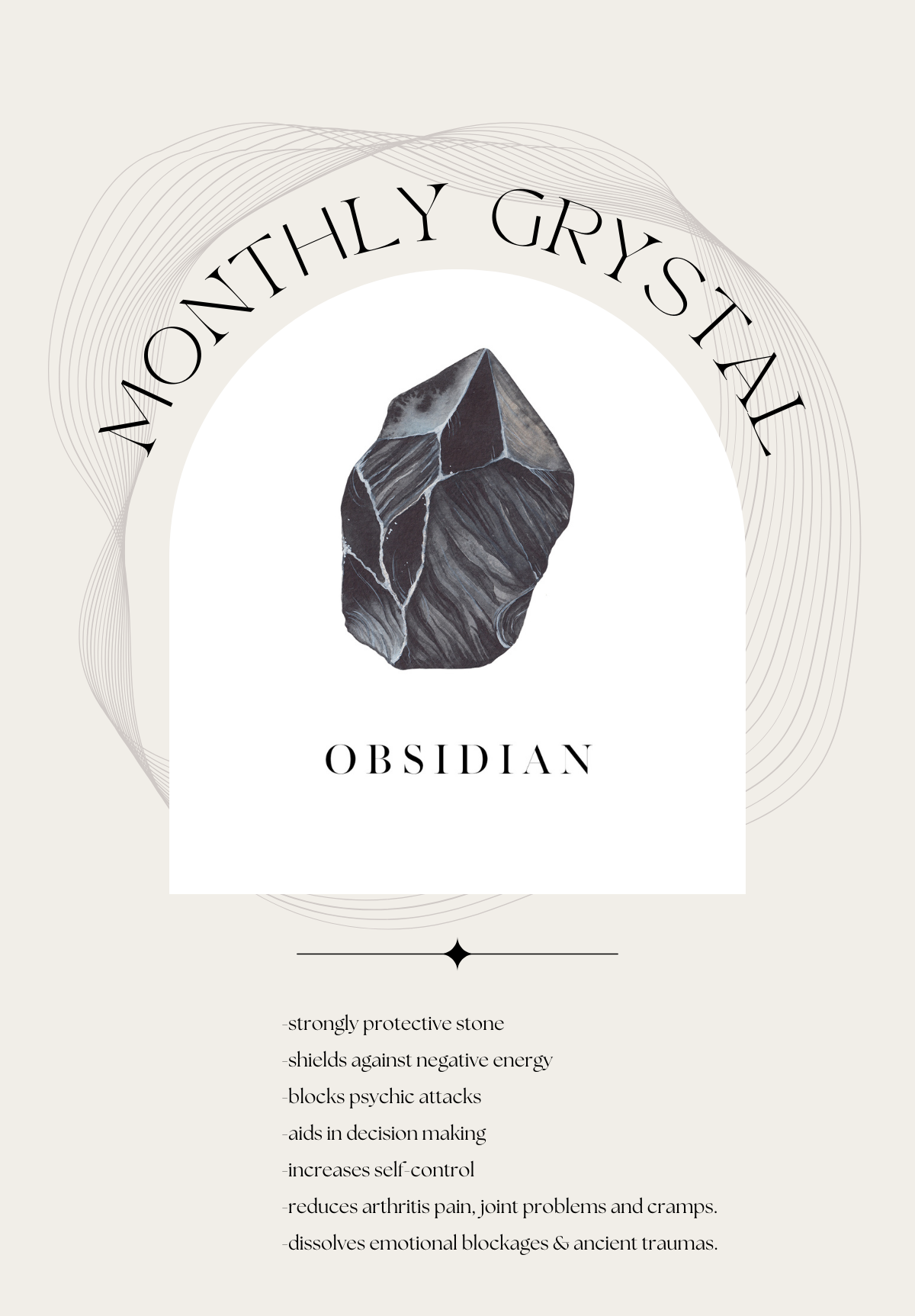
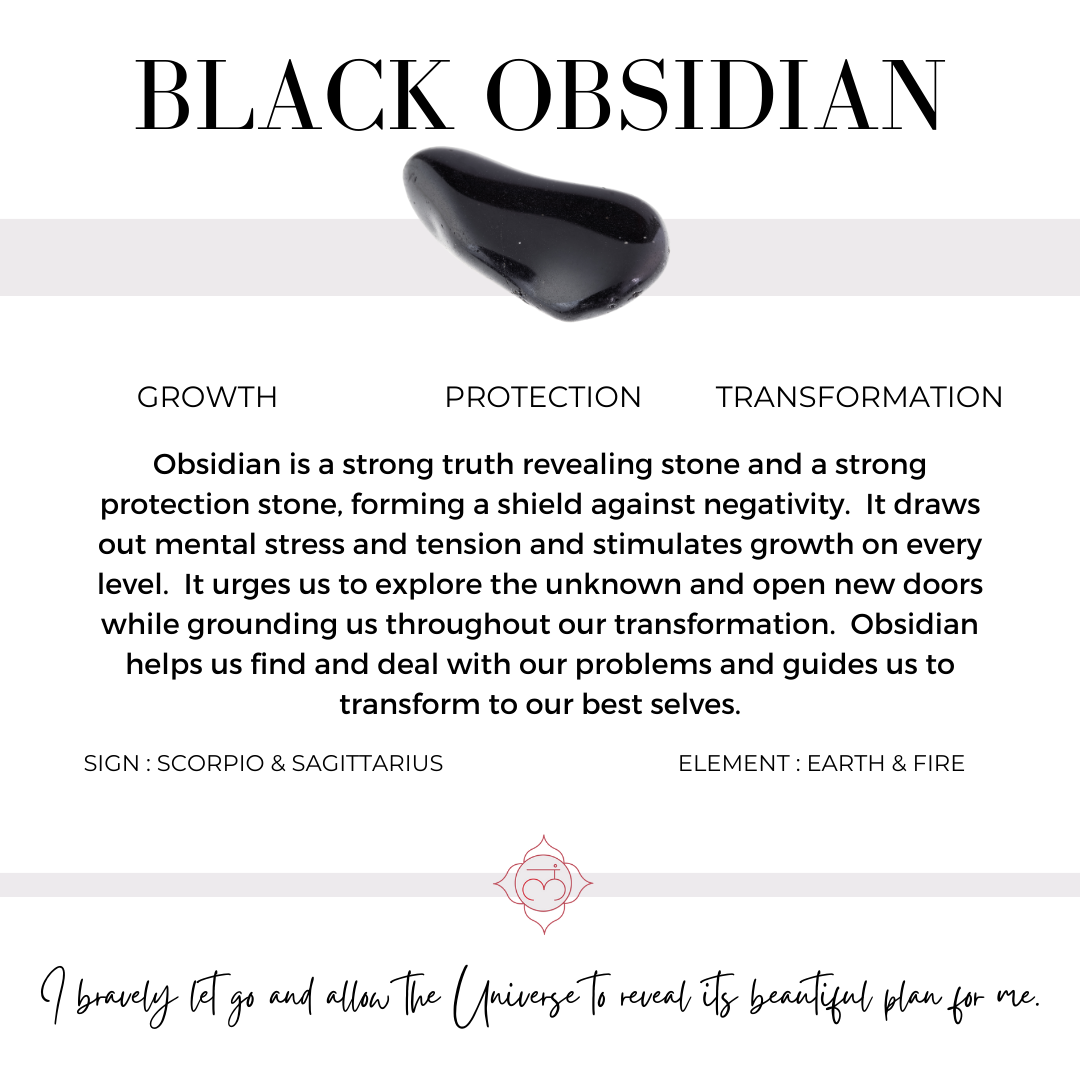
My pick for this months’ Crystal of the Month is Black Obsidian. It’s been long associated with the celebrations of Samhain and other cultural equivalents. Mainly due to it’s protective qualities, it’s a great stone to have around when communicating with spirits. It’s said to be able to ward off any negative or unwanted energies and spirits by creating a protective shield around the wearer, while also preventing psychic attacks by unseen (or even seen) phenomena.
Though it’s not my #1 pick for a protective stone ( I have a preference for Black Tourmaline) it’s classically worn for protection and is in the top 5 of my favorite protective stones of all time.
We sell lots of Black Obsidian in the shop if you ever find yourself in need. We have nice large raw chunks, smaller smooth and tumbled stones, jewelry pieces and some fun carvings. We have a favorite method for helping you choose the right stones, so come in and let us help determine if Black Obsidian is the right protective stone for you.
If you have been reading this blog/newsletter for the past several months, you already know about my fascination with the Victorian Love Language of Flowers. If you haven’t been following along, be sure to read about this topic on my first post here.
Each month I highlight a flower and what it meant in the complex, beautiful, and often weird language communicated through flowers in the Victorian era.
This month I’m highlighting Marigold. Marigold has deep connections to this time of year and is the perfect flower to dive into as we celebrate Autumn, Samhain, and other cultural rituals and celebrations that happen around this time.
First let’s talk about the basics of the Marigold.
The Marigold (Calendula Officinalis) is native to the Americas and there are over a combined 50 species from the North, Central, and South Americas. It is a variety of daisy, and a cousin of the Calendula herb who is also a variety of daisy. It’s important to note that they are not the same flower/herb. However, Marigold is also edible, and often used to adorn gourmet salads and dishes, adding a touch of beauty and whimsy to the dish. If you want to do this, just be sure to get Marigolds grown for this purpose, as they are free from pesticides and other harmful chemicals.
Marigolds make great garden companions! Not only do they attract good insects that are great pollinators like bees, butterflies, and also hummingbirds, but they can ward off pests like nematodes that are harmful to potato and tomato crops. However, it’s important to note that the compound chemicals they produce for this process can be harmful to other certain crop types like beans and legumes. So be sure to do your research on where to plant the Marigolds in your edible garden.
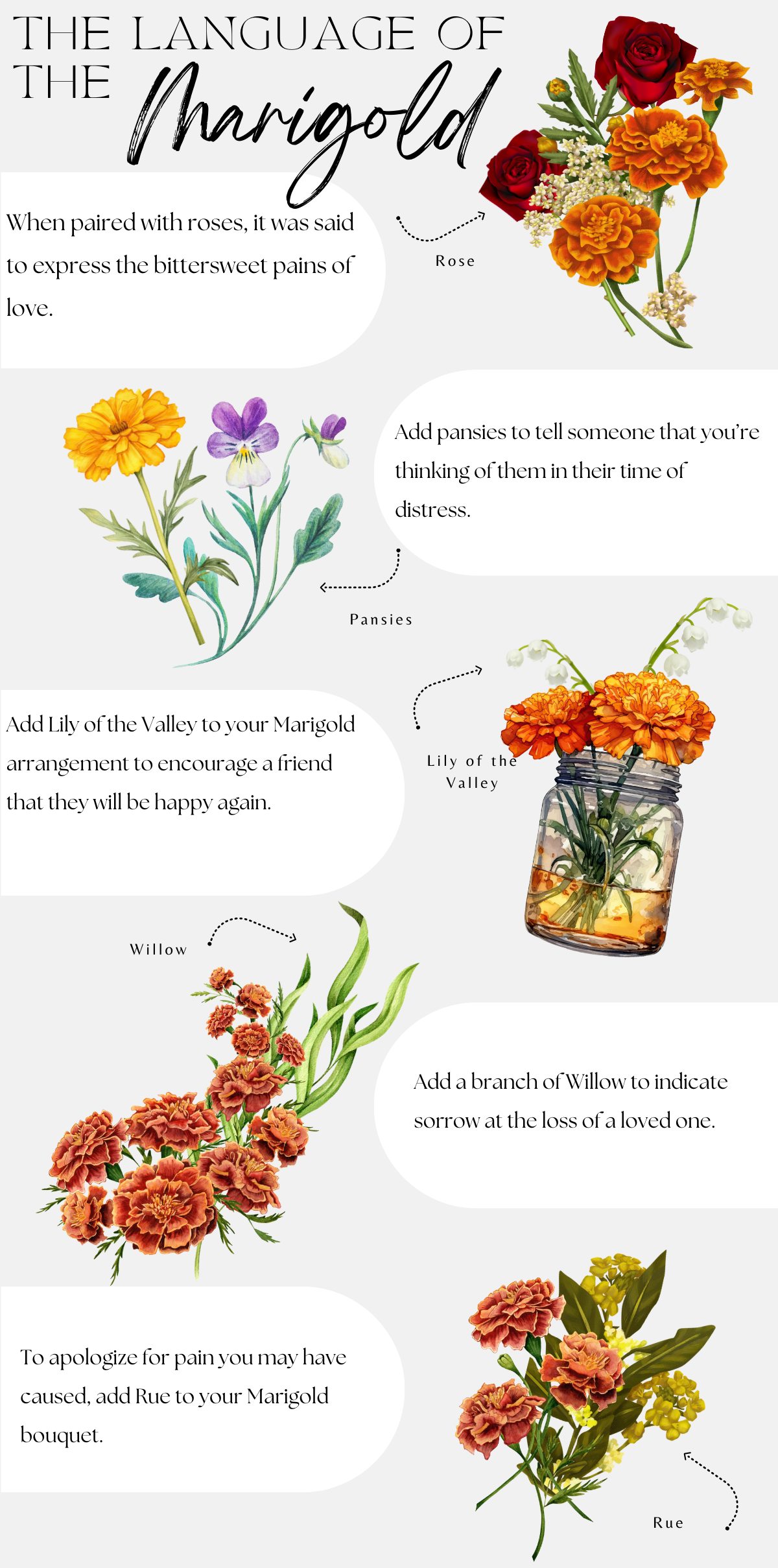
The Victorian Language of the Marigold
Below are some of the ways that the Marigold flower was used to communicate certain feelings and sentiments during the Victorian Era.
The Day of the Dead (Dia de los Muertos)
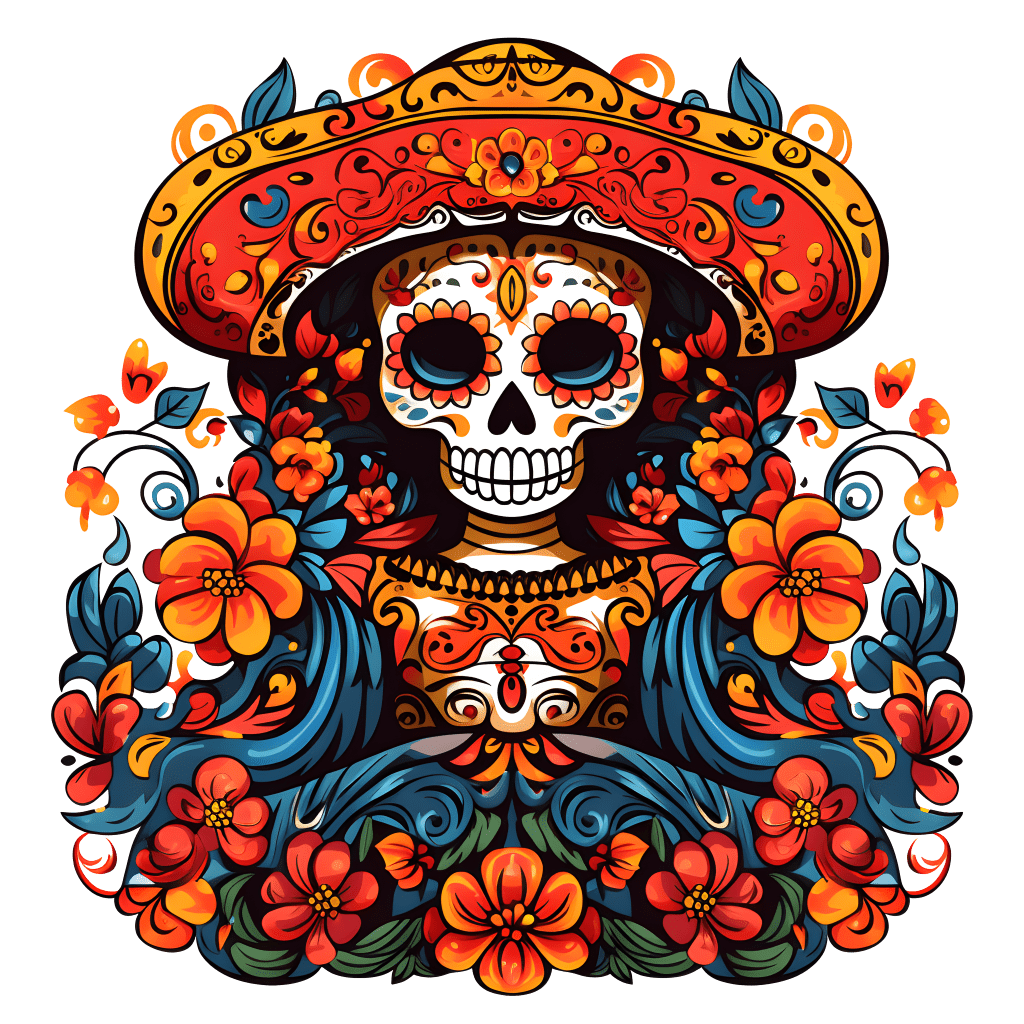
I would be remiss to not mention the association of the Marigold with the beautiful Mexican cultural celebration called Dia de los Muertos (which translates to The Day of the Dead). This is a celebration who has similarities to Samhain, in that it is believed to be a time where the veil between worlds is thin, and communication with spirits is tangible. It’s a time to honor and celebrate ancestors through ritual, prayer, altars, and offerings.
It’s beginnings are linked to Samhain through the Christian threads that tie into Mexico most likely through the Catholic faith and the intermingling (re-creating) of Pagan Holidays/Sabbats into Christian based Holidays like All Saints day and All Souls Day. Mixed with the traditions of the Mesoamerican rituals, Aztec beliefs, and rich Spanish culture, this Holiday was born and embraced in Mexico and has started to gain popularity in North America and other places.
The ancient Aztecs believed in the Goddess Mictecacihuatl, who was known as “The Lady of the Dead”. She was the one who would allow spirits to travel back to the Earth to communicate with their loved ones. It is said that the fragrance of the Marigolds could lead the spirits from their burial places to the homes of their loved ones, and therefore became a tradition to adorn ancestral altars with them in an attempt to honor and communicate with the dearly departed.
It’s a bonus that the Marigold has a beautiful bright color in various shades of orange, that go perfectly with the time of year and the celebrations that come with it!
So if you can find them, put some Marigolds on your ancestral altar if you celebrate Samhain, Dia de lost Muertos, or your own culture/ancestral lineage’s version of this thin-veiled holiday!
 Ink & Amethyst